1

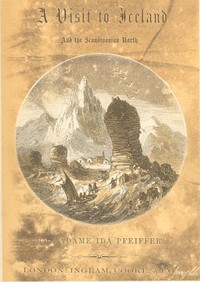
Visit to Iceland and the Scandinavian North — A Closer Reading
(0 User reviews)
325
Project Gutenberg
1999
Not confirmed
Iceland -- Description and travel; Scandinavia -- Description and travel; Old Norse poetry -- History and criticism
Readers of public-domain and historical texts
Project Gutenberg digital edition
en
Edition facts
Words
90,583
Reading time
394 min
Text sections
8
Before opening Visit to Iceland and the Scandinavian North — A Closer Reading, the edition data offers a quick orientation: 90,583 words, 6 hr 34 min estimated reading time, and 8 detected text sections.
The text analysis averages about 24.0 words per sentence, while the detected sections provide another way to judge how the source is divided.
Project Gutenberg metadata also associates the work with “Iceland -- Description and travel,” connecting these edition facts with the source record’s subject description.
Source:
Project Gutenberg record #1894
Ida Pfeiffer's 1851 journey to Iceland and Scandinavia, blending travelogue with observations on landscape, customs, and infrastructure, supplemented by Bergmann's essay on Old Norse poetry.
Read the complete public-domain text at its original source.
Read on Project GutenbergIda Pfeiffer opens her account by anticipating harsh judgment: she expects readers to see her journey as a bid for attention. Yet she insists her motives are simple, tracing her wanderlust to childhood envy of a postilion. This defensive preface sets the tone for a narrative that is at once personal and ethnographic, recording not only landscapes but also the social rituals she witnesses.
The volume is framed by editorial additions—an essay on Icelandic poetry, a translation of the Völuspâ, and a sketch of Icelandic history—that the 1852 London edition presents as complementary to Pfeiffer's travelogue. The catalog subjects (Iceland, Scandinavia, Old Norse poetry) thus reflect a composite work, not a single author's vision.
A Traveler's Defensive Posture
Pfeiffer's preface reveals a writer acutely aware of her anomalous position. She imagines critics accusing her of seeking attention, then counters by describing her lifelong desire to travel—a desire she dates to childhood, when she would stop to gaze at carriages and envy the postilion. This personal history is offered as proof that her journey is not eccentric but natural.
The defensive tone reappears in the editor's advertisement, which notes that the success of A Woman's Journey round the World prompted this volume. The implication is that Pfeiffer's gender and solo travel required justification, a framing that colors the entire narrative. Readers should note that the excerpts do not show how this defensiveness evolves, but the preface establishes a persistent undercurrent of self-explanation.
Landscape as Obstacle and Spectacle
Pfeiffer's descriptions of Iceland's terrain emphasize difficulty: marshy roads, deep rivers, and lava fields that spread "death and destruction." At the Huitha waterfall, she notes the milky-white water and lava shores, but her focus is on the labor of crossing—horses forced to swim, guides shouting and throwing stones. The landscape is not picturesque but demanding.
Yet she also registers beauty: the waterfall's breadth, the lava stream that "seemed to have felt some pity for the beautiful meadows." This tension between hardship and wonder recurs throughout the excerpts. The catalog subject "Iceland—Description and travel" is accurate, but the excerpts suggest a narrative driven by physical struggle as much as scenic appreciation.
Social Customs and the Ethnographic Eye
Pfeiffer's account of a Sunday service at Struvellir is her most detailed social observation. She counts ninety-six attendees, notes the kissing ritual—"welcome and farewell is expressed by a loud kiss"—and remarks on its democratic nature: a farm-labourer kisses the judge's daughters. Her tone is wry: "Every country has its peculiar customs!"
She also records practical details: no inn or stable, so horses are fastened in the open; brandy is brought along; leave-taking is prolonged because "the poor people do not know whether they shall ever meet again." These observations align with the catalog's travel description but also hint at a social structure—priest, judge, farmers—that Pfeiffer does not analyze further. The excerpts offer a snapshot, not a systematic study.
The volume's supplementary materials—Bergmann's essay on Icelandic poetry and the translated Völuspâ—are not represented in these excerpts, so their relationship to Pfeiffer's narrative remains unclear. Readers should approach the travelogue as a personal record shaped by editorial framing, and treat the appended texts as separate contributions. Pfeiffer's voice is direct, often wry, and grounded in the physical realities of mid-nineteenth-century travel.
I have often admired how Pfeiffer, in her Visit to Iceland, finds the strange humbling—glaciers and sagas alike asking little of her but patience. That same quiet fortitude whispers through the Yukon expedition’s account, a river untamed yet met with calm steps. Two travelers, a century apart, sharing one gentle truth: the world endures our passing, and we are better for noticing it. Along Alaska's Great River A Popular Account of the Travels of an Alaska Exploring Expedition along the Great Yukon River, from Its Source to Its Mouth, in the British — A Closer Reading
There are no reviews for this eBook.
There are no comments for this eBook.
Reader reflection
What was your reading experience?
Capture what you thought, learned, and would like to remember.
Your progress
0
/
10
2
How much did you enjoy the reading experience?
3
Would you encourage someone else to read it?
4
How much effort did this book require?
5
Did it raise ideas you would like to talk about?
6
How well did it match your expectations?
7
Would you read this book again?
8
Did the story or argument move comfortably?
9
In one sentence, what did you learn?
10