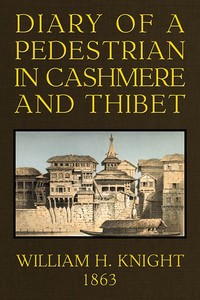
Diary of a Pedestrian in Cashmere and Thibet — Themes and Context
Edition facts
This digital edition of Diary of a Pedestrian in Cashmere and Thibet — Themes and Context is described by source-level measurements including 85,711 words, 6 hr 13 min estimated reading time, and 10 detected text sections.
The text analysis averages about 29.9 words per sentence, while the detected sections provide another way to judge how the source is divided.
Project Gutenberg metadata also associates the work with “Jammu and Kashmir (India) -- Description and travel,” connecting these edition facts with the source record’s subject description.
Calculated from edition completeness, EPUB availability, text structure and catalogue metadata. Not a user rating.
How this score is calculated
- Description quality20 pts
- Title & short description10 pts
- Source metadata20 pts
- Text length15 pts
- Chapters / structure15 pts
- EPUB file integrity20 pts
Total of 100 points, scaled to a 2.5-5.0 range. Editions with an empty description or a missing EPUB file are not scored.
Read the Text
sed out of India, and got further from regions of comparative civilization, his cares increased: cellar, kitchen, larder, farm-yard, tents, &c. had then to accompany our wandering steps, and the expedition gradually increased in size, until it attained its maximum of nearly forty. From this it again as gradually decreased, and as one by one our retainers disappeared, it dwindled in dimensions until it finally reached its original limited proportions, and then “we three met again,” once more upon the plains of India.
All our necessary preparations having been completed, and a sacrifice of three precious weeks having been duly offered to the inexorable genius who presides over public correspondence, we reduced our impedimenta to the smallest possible compass, and with about a hundred pounds to commence life with, all in two shilling pieces, that being the only available coin of the realm in this our second century of British administration, we took our departure by railway for Cawnpore. Here we found ourselves located and hospitably entertained in the house in which our unfortunate fellow-countrywomen were confined on their recapture from the river by the Nana Sahib, one of the few mementos of the mutiny still left standing at Cawnpore.
Next day we laid our dâk for Simla, and about six o’clock in the evening, with the Q.M.G. on the roof, and ourselves and our possessions stowed away in the innumerable holes and corners of the rude wooden construction called a “Dâk garee,” or post coach, we took our departure. After a few mishaps with our steed, involving the necessity of getting out to shove behind, we entered upon the Grand Trunk Road, and with a refreshing sense of freedom and relief, soon left Cawnpore in all its native dust and dreariness behind us.
THE PLEASURES OF THE PLAINS.
May 21, 1860.—Being fairly under weigh, our first attention was directed towards the machine which was to be, in a great measure, our home for many days to come. Not overburdened with springs, and not much to look at, though decidedly an extraordinary one to go, our conveyance was by no means uncomfortable; and, stretched upon a mattress extending its entire length, F. and I chatted over our plans and projects, and star-gazed, and soon fell asleep, in spite of the ruts on the road and the wild discordant bugling of our ragged coachman, who seemed to consider that, however inferior in other respects, in a matter of music we were not to be outdone, not even by Her Majesty’s own royal mail. At first sight, the necessity of trying to clear such lonely roads as we were travelling was not altogether apparent; but a slight acquaintance with the general principles and laws of progression of the national Indian institution called a bullock-cart, or “beil-garee,” soon clears up the difficulty. Built entirely of wood, and held together by scraps of ropes and cord, a more hopeless-looking machine cannot exist; and drivers and bullocks alike share in the general woodenness and impassibility of the structure. The animals, too, having probably lost all the better feelings of their nature in such a service, are appealed to entirely through the medium of their tails, and the operation occasionally results in the whole creaking mass being safely deposited in some capacious rut, there to remain until “the Fates”—assuming, perhaps, the appearance of three additional bullocks—arrive to draw it out again. Occasionally, too, the institution comes to a halt for the night, comfortably drawn up in the centre of the line of traffic, with a delightful disregard for aught but the present, and an air of supreme contempt for the most eloquent music of all the ragged coachmen on the Grand Trunk Road.
Every five miles we stopped to change our horse, and miserable indeed was the raw-boned little animal that made his appearance on every occasion. Still the pace was kept up in spite of appearances, and at seven A.M. we reached “Ghoorsahagunge”—more generally known as Gooseygunge—sixty miles from Cawnpore, and 197 from Delhi.
Here we slept in peace until eleven o’clock, and awoke from dreams of Cashmere to the unpleasant realities of a violent dust-storm. The usual “Khus-khus tatties,” or screens of fragrant grass, which are kept in a continual state of moisture at door and window, and convert the dust-charged scorching blast into a comparative coolness, were not forthcoming, and our halt was not a pleasant one by any means: still our faces were towards the mountains, and the pleasures of hope enabled us to take our misfortunes with entire philosophy. We started again about five P.M., when the power of the sun was somewhat abated, and encountered the usual difficulties with refractory horses at every change. A start was in no case effected without much management and exertion. A half-naked black generally attaches himself to each wheel; the driver, from a post of vantage, belabours the miserable horse with all his might and main; the Q.M.G. takes a firm hold of the rails on the roof; and all shouting, grunting, and using bad language together, away we go at full gallop, if we are in unusual luck, for about 300 yards. Then comes a dead stop: the same operation commences again, and so on, until the animal is sufficiently far from his last stable to be able to look forward with some confidence to the one ahead, and resigns himself to circumstances accordingly. One peculiarity in this peculiar country we found to be, that in putting our steed-to, the English custom is reversed. The cart is “put-to,” not the horse; and the latter being left standing anywhere on the road, the lumbering “garee” is dragged up to his tail, and fastened up with a combination of straps and ropes, marvellous to behold.
May 23.—To-day we arrived at “Etawah,” where we found a very comfortable little staging bungalow, but no supplies of either beer or butter procurable. On the road in the early morning there were herds of deer and antelope in sight, but time being precious we left them unmolested.
As yet very little change makes its appearance in the character of the country. Level plains, with patches of trees, mango and palm, as far as the eye can reach, and everywhere dust, dust, dust! The palm-trees, however, with toddy parties scattered about among them, serve to make the scene look cheerful, and, for an eastern one, comparatively lively. In the evening we again took the road, with a hot wind blowing strongly and steadily, and before long we were overtaken by a dust-storm, which completely enveloped us in its murky folds, and interfered with our happiness a good deal. Got through the night much as usual, with the addition of a midnight vocal entertainment, which some hundreds of wolves and jackals treated us to, while the “authorities” were looking to our welfare, by taking off and greasing our wheels. Of travellers we meet but few, generally bullock-train parties, with soldiers, &c., return dâks, and an occasional old Mussulman, or other native, taking advantage of the early morning for his journey, and wrapped and swaddled up as if afraid of being congealed by the coolness of the morning air.
Every day’s journey leaves one more and more at a loss to discover the sources of the wealth of this enormous country. The soil, for miles and miles a dead flat, is now barren as a desert, and we meet hardly a sign of active traffic. During the night we certainly did encounter a long train of heavily-laden bullock-waggons; but the merchandize was gunpowder, and its destination was up, instead of down the road.
May 24.—Arrived at “Kurga,” where we found neither bread nor butter forthcoming—nothing but—“plenty fowl, Sahib!” In the evening we again encountered a heavy dust-storm, the worst of the season; the whole night it continued to blow in our teeth; and between the fierce dryness of the wind and the searching particles of dust, which visited us without ceremony, we spent anything but an agreeable night. At three A.M. we reached the “Hingus Nuddee,” or river; and changing our solitary horse for two fat bullocks, we crossed its sandy bed, and over a bridge of boats—not so genteelly, perhaps, but much more securely, than we could have otherwise done. There were the remains here of a handsome suspension bridge; but the chains had been cut by the rebel Sepoys, and nothing but the pillars now remained.
May 25.—At four A.M. we crossed the bridge of boats over the Jumna, and found ourselves under the gloomy battlements of the Fort of Delhi.
Entering by the Calcutta Gate, we drove through large suburbs, lighted up with rows of oil lamps, reminding one, in the dim light, a good deal of Cairo. Arriving at the dâk bungalow, we found it such a dirty looking deserted building, and the interior so much of a piece with the exterior, that we mounted again, and set off to try the Hotel, or “Pahunch Ghur,”—a name originally intended to convey the meaning “An arriving house,” but neatly and appropriately corrupted into the term “Punch Gur,” which speaks for itself, and troubles no one much about its derivation. We were rather disappointed with the general appearance of the city: dirt and grandeur were closely combined, and the combination gave the usual impression of shabby genteelness in general, not at first sight prepossessing. After driving through what might have been an Eastern Sebastopol, from the amount of ruin about, we reached a cut-throat-looking archway; and the coachman, here pointing to a dirty board, above his head, triumphantly announced the “Punch Gur!” Hot and thirsty, we got out, with visions of rest and cooling sherbets, too soon to be dispelled. Passing through long dirty halls, and up unsavoury steps, we at last reached a sort of court, with beds of sickly flowers, never known to bloom, and from thence issued to a suite of musty hot Moorish-looking rooms, with gold-inlaid dust-covered tables, and a heavily-draped four-post bedstead, the very sight of which, in such a climate, was almost enough to deprive one of sleep for ever. Our speech forsook us, and without waiting to remark whether the lady of the house was an ogress, or possessed of a “rose-coloured body” and face like the full moon, we fairly turned tail, and drove in all haste to our despised dâk bungalow, where, meekly and with softened feelings towards that edifice, we were glad to deposit ourselves on a couple of charpoys, or “four-legs,” as the bedstead of India is called, and endeavour to sleep the best way we could. “Delhi,” we found, quite kept up its reputation of being the hottest place in India. All idea of sight-seeing was out of the question, and the whole of our energies we were obliged to expend in endeavouring to keep moderately cool.
After enjoying the two first of blessings in a hot climate—viz. a plentiful supply of cold water and a change of raiment, we felt ourselves able to undergo the exertion of meeting the traditional grilled fowl at breakfast, and of inspecting the curiosities from the bazaars. At the first wish on the latter subject, we were invaded by a crowd of bundle-carrying, yellow-turbaned, rascally merchants, who, in half a minute, had the whole of their goods on the floor—rings, brooches, ivory ornaments, and inutilities of all sorts and kinds, all of them exorbitantly dear, and none of any real value.
We left Delhi again at about six P.M., after loitering about the city for a short time, among the teeming bazaars, some parts of which were picturesque and “Eastern” enough. Outside the city walls, the country was ruined and dilapidated in the extreme; demolished houses and wasted gardens telling their tale of the loss of Delhi, and our struggle for its recapture.
May 26.—During the night, we got over seventy-three miles, and reached “Kurnaul” at seven A.M. The bungalow we found unusually comfortable, being a remnant of the old régime, and one of the few which escaped from the hands of the rebels during the mutiny.
The country here begins to improve in appearance—more trees and cultivation on all sides; and the natives appear finer specimens than their more southern relations. The irrigation, too, seems to be carried on with more systematic appliances than further south—the water being raised by the Persian wheel, and bullock-power introduced in aid of manual labour.
May 27.—Arrived at Umballa at three A.M., and found the staging bungalow full. The only available accommodation being a spare charpoy in the verandah, F. took a lease of it, while I revelled in the unaccustomed roominess of the entire carriage, and slept till six, when we got into our lodgings. Although so near the foot of the Himalayas, the weather was so oppressive here that exploring was out of the question; and at six P.M., changing our carriage for palankeens, or doolies, we commenced a tedious and dusty journey to the village of “Kalka,” the veritable “foot of the hills,” where we were met by a string of deputies from the different “dry-lodgings” in the neighbourhood, soliciting custom. The first house we came to was guarded by an unmistakeable English hotel-keeper, of some eighteen stone; and so terrible was the appearance she presented, with her arms akimbo, rejoicing in her mountain air, that in our down-country and dilapidated condition, we felt quite unequal to the exertion of stepping into her little parlour; and passing her establishment—something in the small bathingplace-style of architecture—we went on to the next, very much of the same order, and called the “Brahminee Bull.” Here, to my dismay however, standing in the selfsame position, weighing the same number of stone, and equally confident in the purity of her air as her neighbour, stood another female “Briton,” with the come-into-my-parlour expression of countenance, regarding us as prey. Under the circumstances, exhausted nature gave in; though saved from Scylla, our destiny was Charybdis, and we accordingly surrendered ourselves to a wash, breakfast, and the Brahminee Bull. During the day, we had a visit from a friend and ex-brother officer, whom we had promised to stay with, at “Kussowlie,” on our road up. Kalka was not hot, but grilling, so that a speedy ascent to the station was soon agreed upon. Not caring to risk a sun-stroke, I resigned myself to the traditional conveyance of the country, a “jhampan,” while the other two rode up; but here, for the second time, it was “out of the fryingpan into the fire.” Such an infernal machine as my new conveyance turned out never could have existed in the palmiest days of the Inquisition. It was a sort of child’s cradle, long enough for a creature of some five or six summers, made like a tray, and hung after the fashion of a miniature four-post bedstead, with goat’s-hair curtains. The structure is suspended, something in the fashion of a sedan-chair which has been stunted in its growth, between two poles; between the projections of these again, before and behind, connected by a stout strap, are two shorter bars, each supported, when in travelling order, on the shoulders of two bearers. When the machine is in motion, therefore, there are four men in line between the shafts.
The pace is always rather fast, and down a declivity the torturers go at a run; the result is, that prominent parts of one’s body are continually in collision with the seat or sides of the machine, coming down from various altitudes, according to the nature of the ground and the humour of the inquisitors. After getting over about six miles in this graceful and pleasing manner, we reached the first of the fir-trees, and as we rose still higher a delicious breeze came over the hills, as precious to the parched and travel-stained pilgrim from the plains as a drop of water to the thirstiest wanderer in the desert. Kussowlie appeared a picturesque little station, perched at the summit of one of the first of the hilly ranges, and here I found my two companions, burnt and red in the face as if they, too, had had their sufferings on the road, occupied in looking over the goods of a strolling Cashmere merchant; luckily for themselves, however, it was under the protecting superintendence of our hostess. Our friends were living on a miniature estate commanding a magnificent view of the mountain ranges on one side, and, on the other, the plains of the Punjab, the scorching country from which we had just made our escape lying stretched out before us like an enormous map in relief. Towards the mountains were the military stations of “Dugshai” and “Subathoo,” and the boys’ asylum of “Senore,” the latter rather marring the face of nature by the workhouse order of its architecture. “Simla” we could just distinguish, nestled among the blue mountains in the far distance.
Here we spent a couple of days very pleasantly with our hospitable entertainers, and satisfactorily pulled up all arrears of sleep—a luxury none can really appreciate who have not travelled for six days and nights in the different local conveniences I have mentioned.
Before leaving we had an opportunity of seeing how England in the Himalayas makes its morning calls. Walking, which amounts almost to an impossibility in “the plains,” seems to be voted infra dig. in “the hills,” and Mrs. Kussowlie according made her appearance seated in state in a jhampan, and borne on the shoulders of four of her slaves.
These were active, wiry-looking natives, dressed in long green coats, bound with broad, red, tight-fitting pantaloons, and with small turbans of red and green on their heads. Altogether, a more startling-looking apparition to the uninitiated than this Himalayan morning visitor could hardly be imagined, even in a tour through the remotest regions of the earth.
Captain W. H. Knight, a British officer of the Forty-eighth Regiment, presents his Diary of a Pedestrian in Cashmere and Thibet as an unpolished, firsthand account—'sketched and written during the leisure moments of a wandering life.' The narrative, originally private, was published in 1863 with minimal alteration, and Knight openly acknowledges his lack of prior acquaintance with other travel writers on the region. What emerges is a record marked by a dry, self-deprecating tone and a keen eye for the absurdities of cross-cultural encounter.
The Sepoy and the Pig-Tail
One of the most vivid figures in the diary is Dilour Khan, a sepoy whose name Knight translates as 'the Invincible One.' Knight portrays him as a 'fierce-looking soldier' who terrorizes local Tibetans to procure supplies. His method is described with comic precision: 'throwing aloft his sword, and relinquishing his umbrella, he used to seize suddenly upon a pig-tail, and, handling it after the fashion of a bell-rope, proceed to insist upon the production of impossible mutton.' The sepoy's theatricality—delivering a 'volley of Thibetian' while gesticulating and curling his moustaches—underscores the power dynamics at play. Knight himself admits to a 'weak moment' when he assaulted Dilour Khan, only to watch the sepoy redirect his violence onto villagers, forcing Knight to intervene. This episode reveals the tension between the author's authority and his dependence on a subordinate whose methods he both deplores and finds darkly amusing.
A Prayer Roll of Astonishing Length
Knight encounters a Buddhist prayer roll that he describes with a mixture of ethnographic curiosity and ironic disdain. The roll, 'sixty yards long,' is composed of strips of thin paper, each containing the phrase 'Ûm mani panee' repeated 170 times. He calculates that the entire roll holds between seventeen and eighteen thousand repetitions. The object is enclosed in a canvas cover 'open at both ends' and marked with what Knight speculates is 'the official seal of the particular society for the diffusion of ignorance at Lassa.' This wry characterization—calling the monastery a 'society for the diffusion of ignorance'—reflects his inability to penetrate the meaning of the mantra, which 'all appeared so ready to pronounce and none seemed able to explain.' The passage highlights the limits of Knight's understanding and his tendency to frame unfamiliar religious practices through a lens of British skepticism.
Negotiating a Necklace and the Fragility of Bargains
Near Pitok, Knight purchases a necklace of amber and turquoise from an old woman weaving goat's-hair cloth. The transaction is fraught: she takes two rupees for 'the family jewels' and then 'seemed in a desperate fright at what she had done, looking about in every direction to see that no avaricious old Lama was near.' The woman's fear of being caught by a Lama or a gossip reveals the social constraints operating beneath the surface of trade. Knight, as an outsider, becomes an unwitting catalyst for her anxiety. This brief scene encapsulates the precariousness of cross-cultural exchange in the region, where a simple sale could carry risks for the seller that the buyer barely perceives.
Knight's diary resists easy categorization: it is part travelogue, part military memoir, and part ethnographic sketch, all filtered through a personality that is by turns self-deprecating, observant, and unapologetically colonial. Readers should approach the text as a document of its time, noting where Knight's irony reveals more about his own assumptions than about the places he describes. The appended notes, drawn from scholars like Captain Cunningham, offer a counterpoint to the diary's spontaneous voice.
That rainy afternoon, I drifted through Captain Knight’s Kashmir, half-laughing at Dilour Khan and the endless ‘Ûm mani panee.’ His weary shrug at repetition stayed with me. Later, almost without thinking, I found myself inside Along Alaska's Great River A Popular Account of the Travels of an Alaska Exploring Expedition along the Great Yukon River, from Its Source to Its Mouth, in the British — A Closer Reading—a different river, same quiet relentlessness of motion and patience against vast, indifferent land.
Sophia Thompson
2 weeks agoJoseph King
2 weeks agoEmma King
3 weeks agoLiam Wright
2 weeks agoHow will you remember this book?
Save your reaction, strongest insight, and memorable passage.
Daniel Wilson
3 weeks ago