1

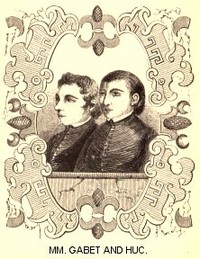
Travels in Tartary, Thibet, and China during the years 1844-5-6. Volume 1 — Key Ideas to Explore
2
1
Project Gutenberg
2010
China -- Description and travel; Tibet Autonomous Region (China) -- Description and travel; Asia, Central -- Description and travel
Readers of public-domain and historical texts
Project Gutenberg digital edition
en
Edition facts
Words: 128,868
Reading time: 561 min
Text sections: 11
Source:
Project Gutenberg record #32747
Huc's account of his 1844-1846 journey through Mongolia, Tibet, and China, translated by William Hazlitt, reveals a missionary's eye for detail in dialogue, description, and cultural encounter, from bargaining for fish to debating metempsychosis.
Evariste Régis Huc's narrative, translated by William Hazlitt, opens with a preface that frames the journey as a papal mission to establish an Apostolic Vicariat in Mongolia, yet the text quickly shifts from ecclesiastical purpose to ground-level observation. Huc's prose, rendered in English by Hazlitt, is notable for its precise rendering of dialogue and its attention to the mundane details of travel—bargaining for boat fares, preparing meals, and negotiating with local authorities. The excerpts show a writer who records not only landscapes and customs but also the rhythms of conversation, as when a fisherman explains why he throws back small fish: 'We do not hope to re-capture these fish. Every year the basin is filled with fresh fish.' Such moments give the work a documentary texture that transcends its missionary frame.
Dialogue as Cultural Record
Huc frequently lets his interlocutors speak at length, embedding their words within his narrative. The exchange with the fisherman on the Hoang-Ho is a case in point: the fisherman's explanation of seasonal fish cycles—'the basin is filled with fresh fish, brought hither by the overflowings of the Hoang-Ho'—reveals local ecological knowledge. Huc does not simply summarize; he reproduces the back-and-forth, including his own offer to take the small fish and the fisherman's pragmatic response. This method extends to his interactions with Samdadchiemba, the Dchiahour servant, whose objections to killing live fish on metempsychotic grounds are met with the missionaries' teasing: 'Do you still think that men are transformed into beasts, and beasts into men?' The dialogue captures competing worldviews without editorializing.
The Texture of Daily Travel
Huc's descriptions of travel routines are dense with sensory and practical detail. When the missionaries return to their tent with fish, Samdadchiemba's irritation at their prolonged absence is conveyed through his repetitive complaint: 'the tea is now boiled, and it soon gets cold: I have boiled it up again; it has again got cold.' The scene then pivots to the preparation of the fish—scaling, frying in mutton fat—and the resolution of the servant's mood. Huc also notes the method of preserving fish in northern China: freezing them overnight and storing them for winter, with the caveat that 'on the first thaw the fish become putrid.' Such passages ground the narrative in the material realities of travel, from food to weather to the negotiation of boat fares that 'appeared to us exorbitant.'
Voice and Character Through Speech
Samdadchiemba emerges as a distinct personality through his speech patterns and physical descriptions. Huc notes his 'forehead was more contracted than usual, and his small black eyes flashed with displeasure' before the fish appear, then his face 'relaxed into a smile' at the sight of them. His dialogue is marked by a kind of literal-mindedness: when reminded of the doctrine of metempsychosis, he strikes his forehead and says, 'Bah! what a thick head I have; I did not think of that; I had forgotten the doctrine.' The missionaries' own voices are equally distinctive—teasing, pragmatic, and occasionally imperious. The preface, written by the translator or editor, describes the missionaries as possessing 'French elasticity,' a phrase that hints at the cultural lens through which their adventures are presented.
Structure and the Role of the Translator
The work's structure is shaped by its origin: a spoken account by M. Gabet, transcribed by Alexander Johnstone, passed to Sir John Davis, and eventually expanded by Huc into two volumes. This chain of transmission—from oral to written, from French to English—is acknowledged in the preface, which notes that the translation by William Hazlitt renders Huc's French into English. The excerpts show Hazlitt's English prose as fluent and idiomatic, preserving the rhythms of Huc's observations. The narrative moves between descriptive passages, dialogue, and explanatory asides, such as the note on fish preservation. The result is a text that feels both immediate and mediated, a record of travel filtered through multiple hands yet retaining a vivid, first-person quality.
Readers approaching this volume should attend to the interplay between Huc's missionary purpose and his ethnographic eye. The narrative does not simply recount events; it preserves the voices of those encountered—fishermen, servants, officials—and the textures of daily life on the road. The translation by Hazlitt, while fluent, carries its own historical context, and the preface's framing of the mission as 'Papal aggression in the East' invites reflection on the political dimensions of the journey. For those interested in nineteenth-century travel writing, this work offers a detailed, dialogue-rich account of regions then little known to Europeans.
Reader reflection
What was your reading experience?
Capture what you thought, learned, and would like to remember.
Your progress
0
/
10
2
Was reading this book enjoyable?
3
Would you encourage someone else to read it?
4
What was the reading difficulty like?
5
How much did the book move you?
6
How personally connected did you feel to the book?
7
Could you apply anything you learned?
8
Do you expect to return to this book?
9
Which lesson or insight stayed with you?
10