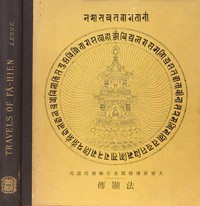
A Record of Buddhistic Kingdoms Being an account by the Chinese monk Fa-hsien of travels in India and Ceylon (A.D. 399-414) in search of the Buddhist books of discipline — A Reader’s Guide

(2 User reviews)   336
In Category - Places Peoples
Faxian, 337?-422?, Legge, James, 1815-1897 [Translator] Project Gutenberg 2006 Not confirmed
Buddhist pilgrims and pilgrimages -- India -- Early works to 1800; Buddhism -- Early works to 1800; Asia -- Description and travel -- Early works to 1800 Readers of public-domain and historical texts
Project Gutenberg digital edition en

Edition facts

Words 53,592
Reading time 234 min
Text sections 43

Before opening A Record of Buddhistic Kingdoms Being an account by the Chinese monk Fa-hsien of travels in India and Ceylon (A.D. 399-414) in search of the Buddhist books of discipline — A Reader’s Guide, the edition data offers a quick orientation: 53,592 words, 3 hr 54 min estimated reading time, and 43 detected text sections.

The text analysis averages about 20.4 words per sentence, while the detected sections provide another way to judge how the source is divided.

Project Gutenberg metadata also associates the work with “Buddhist pilgrims and pilgrimages -- India -- Early works to 1800,” connecting these edition facts with the source record’s subject description.

James Legge's annotated translation of Faxian's 5th-century pilgrimage record, with detailed notes on Buddhist terminology and textual variants from a Japanese edition.
Share
Editorial Edition Score 4.9/5

Calculated from edition completeness, EPUB availability, text structure and catalogue metadata. Not a user rating.

How this score is calculated
  • Description quality20 pts
  • Title & short description10 pts
  • Source metadata20 pts
  • Text length15 pts
  • Chapters / structure15 pts
  • EPUB file integrity20 pts

Total of 100 points, scaled to a 2.5-5.0 range. Editions with an empty description or a missing EPUB file are not scored.

Edition quality

Read the Text

CHAPTER I. CHAPTER II. CHAPTER III. CHAPTER IV. CHAPTER V. CHAPTER VI. CHAPTER VII. CHAPTER VIII. CHAPTER IX. CHAPTER X. CHAPTER XI. CHAPTER XII. CHAPTER XIII. CHAPTER XIV. CHAPTER XV. CHAPTER XVI. CHAPTER XVII. CHAPTER XVIII. CHAPTER XIX. CHAPTER XX. CHAPTER XXI. CHAPTER XXII. CHAPTER XXIII. CHAPTER XXIV. CHAPTER XXV. CHAPTER XXVI. CHAPTER XXVII. CHAPTER XXVIII. CHAPTER XXIX. CHAPTER XXX. CHAPTER XXXI. CHAPTER XXXII. CHAPTER XXXIII. CHAPTER XXXIV. CHAPTER XXXV. CHAPTER XXXVI. CHAPTER XXXVII. CHAPTER XXXVIII. CHAPTER XXXIX. CHAPTER XL.

Several times during my long residence in Hong Kong I endeavoured to read through the “Narrative of Fâ-Hien;” but though interested with the graphic details of much of the work, its columns bristled so constantly—now with his phonetic representations of Sanskrit words, and now with his substitution for them of their meanings in Chinese characters, and I was, moreover, so much occupied with my own special labours on the Confucian Classics, that my success was far from satisfactory. When Dr. Eitel’s “Handbook for the Student of Chinese Buddhism” appeared in 1870, the difficulty occasioned by the Sanskrit words and names was removed, but the other difficulty remained; and I was not able to look into the book again for several years. Nor had I much inducement to do so in the two copies of it which I had been able to procure, on poor paper, and printed from blocks badly cut at first, and so worn with use as to yield books the reverse of attractive in their appearance to the student.

In the meantime I kept studying the subject of Buddhism from various sources; and in 1878 began to lecture, here in Oxford, on the Travels with my Davis Chinese scholar, who was at the same time Boden Sanskrit scholar. As we went on, I wrote out a translation in English for my own satisfaction of nearly half the narrative. In the beginning of last year I made Fâ-Hien again the subject of lecture, wrote out a second translation, independent of the former, and pushed on till I had completed the whole.

The want of a good and clear text had been supplied by my friend, Mr. Bunyiu Nanjio, who sent to me from Japan a copy, the text of which is appended to the translation and notes, and of the nature of which some account is given in the Introduction, and towards the end of this Preface.

The present work consists of three parts: the Translation of Fâ-Hien’s Narrative of his Travels; copious Notes; and the Chinese Text of my copy from Japan.

It is for the Translation that I hold myself more especially responsible. Portions of it were written out three times, and the whole of it twice. While preparing my own version I made frequent reference to previous translations:—those of M. Abel Rémusat, “Revu, complété, et augmenté d’éclaircissements nouveaux par MM. Klaproth et Landress” (Paris, 1836); of the Rev. Samuel Beal (London, 1869), and his revision of it, prefixed to his “Buddhist Records of the Western World” (Trübner’s Oriental Series, 1884); and of Mr. Herbert A. Giles, of H.M.’s Consular Service in China (1877). To these I have to add a series of articles on “Fa-hsien and his English Translators,” by Mr. T. Watters, British Consul at Î-Chang (China Review, 1879, 1880). Those articles are of the highest value, displaying accuracy of Chinese scholarship and an extensive knowledge of Buddhism. I have regretted that Mr. Watters, while reviewing others, did not himself write out and publish a version of the whole of Fâ-Hien’s narrative. If he had done so, I should probably have thought that, on the whole, nothing more remained to be done for the distinguished Chinese pilgrim in the way of translation. Mr. Watters had to judge of the comparative merits of the versions of Beal and Giles, and pronounce on the many points of contention between them. I have endeavoured to eschew those matters, and have seldom made remarks of a critical nature in defence of renderings of my own.

The Chinese narrative runs on without any break. It was Klaproth who divided Rémusat’s translation into forty chapters. The division is helpful to the reader, and I have followed it excepting in three or four instances. In the reprinted Chinese text the chapters are separated by a circle in the column.

In transliterating the names of Chinese characters I have generally followed the spelling of Morrison rather than the Pekinese, which is now in vogue. We cannot tell exactly what the pronunciation of them was, about fifteen hundred years ago, in the time of Fâ-Hien; but the southern mandarin must be a shade nearer to it than that of Peking at the present day. In transliterating the Indian names I have for the most part followed Dr. Eitel, with such modification as seemed good and in harmony with growing usage.

For the Notes I can do little more than claim the merit of selection and condensation. My first object in them was to explain what in the text required explanation to an English reader. All Chinese texts, and Buddhist texts especially, are new to foreign students. One has to do for them what many hundreds of the ablest scholars in Europe have done for the Greek and Latin Classics during several hundred years, and what the thousands of critics and commentators have been doing of our Sacred Scriptures for nearly eighteen centuries. There are few predecessors in the field of Chinese literature into whose labours translators of the present century can enter. This will be received, I hope, as a sufficient apology for the minuteness and length of some of the notes. A second object in them was to teach myself first, and then others, something of the history and doctrines of Buddhism. I have thought that they might be learned better in connexion with a lively narrative like that of Fâ-Hien than by reading didactic descriptions and argumentative books. Such has been my own experience. The books which I have consulted for these notes have been many, besides Chinese works. My principal help has been the full and masterly handbook of Eitel, mentioned already, and often referred to as E.H. Spence Hardy’s “Eastern Monachism” (E.M.) and “Manual of Buddhism” (M.B.) have been constantly in hand, as well as Rhys Davids’ Buddhism, published by the Society for Promoting Christian Knowledge, his Hibbert Lectures, and his Buddhist Suttas in the Sacred Books of the East, and other writings. I need not mention other authorities, having endeavoured always to specify them where I make use of them. My proximity and access to the Bodleian Library and the Indian Institute have been of great advantage.

I may be allowed to say that, so far as my own study of it has gone, I think there are many things in the vast field of Buddhist literature which still require to be carefully handled. How far, for instance, are we entitled to regard the present Sûtras as genuine and sufficiently accurate copies of those which were accepted by the Councils before our Christian era? Can anything be done to trace the rise of the legends and marvels of Sâkyamuni’s history, which were current so early (as it seems to us) as the time of Fâ-Hien, and which startle us so frequently by similarities between them and narratives in our Gospels? Dr. Hermann Oldenberg, certainly a great authority on Buddhistic subjects, says that “a biography of Buddha has not come down to us from ancient times, from the age of the Pâli texts; and, we can safely say, no such biography existed then” (“Buddha—His Life, His Doctrine, His Order,” as translated by Hoey, p. 78). He has also (in the same work, pp. 99, 416, 417) come to the conclusion that the hitherto unchallenged tradition that the Buddha was “a king’s son” must be given up. The name “king’s son” (in Chinese {...}), always used of the Buddha, certainly requires to be understood in the highest sense. I am content myself to wait for further information on these and other points, as the result of prolonged and careful research.

Dr. Rhys Davids has kindly read the proofs of the Translation and Notes, and I most certainly thank him for doing so, for his many valuable corrections in the Notes, and for other suggestions which I have received from him. I may not always think on various points exactly as he does, but I am not more forward than he is to say with Horace,—

“Nullius addictus jurare in verba magistri.”

I have referred above, and also in the Introduction, to the Corean text of Fâ-Hien’s narrative, which I received from Mr. Nanjio. It is on the whole so much superior to the better-known texts, that I determined to attempt to reproduce it at the end of the little volume, so far as our resources here in Oxford would permit. To do so has not been an easy task. The two fonts of Chinese types in the Clarendon Press were prepared primarily for printing the translation of our Sacred Scriptures, and then extended so as to be available for printing also the Confucian Classics; but the Buddhist work necessarily requires many types not found in them, while many other characters in the Corean recension are peculiar in their forms, and some are what Chinese dictionaries denominate “vulgar.” That we have succeeded so well as we have done is owing chiefly to the intelligence, ingenuity, and untiring attention of Mr. J. C. Pembrey, the Oriental Reader.

The pictures that have been introduced were taken from a superb edition of a History of Buddha, republished recently at Hang-châu in Cheh-kiang, and profusely illustrated in the best style of Chinese art. I am indebted for the use of it to the Rev. J. H. Sedgwick, University Chinese Scholar.

The accompanying Sketch-Map, taken in connexion with the notes on the different places in the Narrative, will give the reader a sufficiently accurate knowledge of Fâ-Hien’s route.

There is no difficulty in laying it down after he crossed the Indus from east to west into the Punjâb, all the principal places, at which he touched or rested, having been determined by Cunningham and other Indian geographers and archaeologists. Most of the places from Ch’ang-an to Bannu have also been identified. Woo-e has been put down as near Kutcha, or Kuldja, in 43° 25′ N., 81° 15′ E. The country of K’ieh-ch’a was probably Ladak, but I am inclined to think that the place where the traveller crossed the Indus and entered it must have been further east than Skardo. A doubt is intimated on page 24 as to the identification of T’o-leih with Darada, but Greenough’s “Physical and Geological Sketch-Map of British India” shows “Dardu Proper,” all lying on the east of the Indus, exactly in the position where the Narrative would lead us to place it. The point at which Fâ-Hien recrossed the Indus into Udyâna on the west of it is unknown. Takshasila, which he visited, was no doubt on the west of the river, and has been incorrectly accepted as the Taxila of Arrian in the Punjâb. It should be written Takshasira, of which the Chinese phonetisation will allow;—see a note of Beal in his “Buddhist Records of the Western World,” i. 138.

We must suppose that Fâ-Hien went on from Nan-king to Ch’ang-an, but the Narrative does not record the fact of his doing so.

Life of Fâ-Hien; Genuineness and Integrity of the Text of his Narrative; Number of the Adherents of Buddhism.

1. Nothing of great importance is known about Fâ-Hien in addition to what may be gathered from his own record of his travels. I have read the accounts of him in the “Memoirs of Eminent Monks,” compiled in A.D. 519, and a later work, the “Memoirs of Marvellous Monks,” by the third emperor of the Ming dynasty (A.D. 1403-1424), which, however, is nearly all borrowed from the other; and all in them that has an appearance of verisimilitude can be brought within brief compass.

His surname, they tell us, was Kung, and he was a native of Wû-yang in P’ing-Yang, which is still the name of a large department in Shan-hsi. He had three brothers older than himself; but when they all died before shedding their first teeth, his father devoted him to the service of the Buddhist society, and had him entered as a Sramanera, still keeping him at home in the family. The little fellow fell dangerously ill, and the father sent him to the monastery, where he soon got well and refused to return to his parents.

When he was ten years old, his father died; and an uncle, considering the widowed solitariness and helplessness of the mother, urged him to renounce the monastic life, and return to her, but the boy replied, “I did not quit the family in compliance with my father’s wishes, but because I wished to be far from the dust and vulgar ways of life. This is why I chose monkhood.” The uncle approved of his words and gave over urging him. When his mother also died, it appeared how great had been the affection for her of his fine nature; but after her burial he returned to the monastery.

On one occasion he was cutting rice with a score or two of his fellow-disciples, when some hungry thieves came upon them to take away their grain by force. The other Sramaneras all fled, but our young hero stood his ground, and said to the thieves, “If you must have the grain, take what you please. But, Sirs, it was your former neglect of charity which brought you to your present state of destitution; and now, again, you wish to rob others. I am afraid that in the coming ages you will have still greater poverty and distress;—I am sorry for you beforehand.” With these words he followed his companions into the monastery, while the thieves left the grain and went away, all the monks, of whom there were several hundred, doing homage to his conduct and courage.

When he had finished his noviciate and taken on him the obligations of the full Buddhist orders, his earnest courage, clear intelligence, and strict regulation of his demeanour were conspicuous; and soon after, he undertook his journey to India in search of complete copies of the Vinaya-pitaka. What follows this is merely an account of his travels in India and return to China by sea, condensed from his own narrative, with the addition of some marvellous incidents that happened to him, on his visit to the Vulture Peak near Rajagriha.

It is said in the end that after his return to China, he went to the capital (evidently Nanking), and there, along with the Indian Sramana Buddha-bhadra, executed translations of some of the works which he had obtained in India; and that before he had done all that he wished to do in this way, he removed to King-chow (in the present Hoo-pih), and died in the monastery of Sin, at the age of eighty-eight, to the great sorrow of all who knew him. It is added that there is another larger work giving an account of his travels in various countries.

Such is all the information given about our author, beyond what he himself has told us. Fâ-Hien was his clerical name, and means “Illustrious in the Law,” or “Illustrious master of the Law.” The Shih which often precedes it is an abbreviation of the name of Buddha as Sâkyamuni, “the Sakya, mighty in Love, dwelling in Seclusion and Silence,” and may be taken as equivalent to Buddhist. It is sometimes said to have belonged to “the eastern Tsin dynasty” (A.D. 317-419), and sometimes to “the Sung,” that is, the Sung dynasty of the House of Liu (A.D. 420-478). If he became a full monk at the age of twenty, and went to India when he was twenty-five, his long life may have been divided pretty equally between the two dynasties.

2. If there were ever another and larger account of Fâ-Hien’s travels than the narrative of which a translation is now given, it has long ceased to be in existence.

In the Catalogue of the imperial library of the Suy dynasty (A.D. 589-618), the name Fâ-Hien occurs four times. Towards the end of the last section of it (page 22), after a reference to his travels, his labours in translation at Kin-ling (another name for Nanking), in conjunction with Buddha-bhadra, are described. In the second section, page 15, we find “A Record of Buddhistic Kingdoms;”—with a note, saying that it was the work of the “Sramana, Fâ-Hien;” and again, on page 13, we have “Narrative of Fâ-Hien in two Books,” and “Narrative of Fâ-Hien’s Travels in one Book.” But all these three entries may possibly belong to different copies of the same work, the first and the other two being in separate subdivisions of the Catalogue.

In the two Chinese copies of the narrative in my possession the title is “Record of Buddhistic Kingdoms.” In the Japanese or Corean recension subjoined to this translation, the title is twofold; first, “Narrative of the Distinguished Monk, Fâ-Hien;” and then, more at large, “Incidents of Travels in India, by the Sramana of the Eastern Tsin, Fâ-Hien, recorded by himself.”

There is still earlier attestation of the existence of our little work than the Suy Catalogue. The Catalogue Raisonné of the imperial library of the present dynasty (chap. 71) mentions two quotations from it by Le Tao-yuen, a geographical writer of the dynasty of the Northern Wei (A.D. 386-584), one of them containing 89 characters, and the other 276; both of them given as from the “Narrative of Fâ-Hien.”

In all catalogues subsequent to that of Suy our work appears. The evidence for its authenticity and genuineness is all that could be required. It is clear to myself that the “Record of Buddhistic Kingdoms” and the “Narrative of his Travels by Fâ-Hien” were designations of one and the same work, and that it is doubtful whether any larger work on the same subject was ever current. With regard to the text subjoined to my translation, it was published in Japan in 1779. The editor had before him four recensions of the narrative; those of the Sung and Ming dynasties, with appendixes on the names of certain characters in them; that of Japan; and that of Corea. He wisely adopted the Corean text, published in accordance with a royal rescript in 1726, so far as I can make out; but the different readings of the other texts are all given in top-notes, instead of foot-notes as with us, this being one of the points in which customs in the east and west go by contraries. Very occasionally, the editor indicates by a single character, equivalent to “right” or “wrong,” which reading in his opinion is to be preferred. In the notes to the present republication of the Corean text, S stands for Sung, M for Ming, and J for Japanese; R for right, and W for wrong. I have taken the trouble to give all the various readings (amounting to more than 300), partly as a curiosity and to make my text complete, and partly to show how, in the transcription of writings in whatever language, such variations are sure to occur,

“maculae, quas aut incuria fudit, Aut humana parum cavit nature,”

while on the whole they very slightly affect the meaning of the document.

The editors of the Catalogue Raisonné intimate their doubts of the good taste and reliability of all Fâ-Hien’s statements. It offends them that he should call central India the “Middle Kingdom,” and China, which to them was the true and only Middle Kingdom, but “a Border land;”—it offends them as the vaunting language of a Buddhist writer, whereas the reader will see in the expressions only an instance of what Fâ-Hien calls his “simple straightforwardness.”

As an instance of his unreliability they refer to his account of the Buddhism of Khoten, whereas it is well known, they say, that the Khoteners from ancient times till now have been Mohammedans;—as if they could have been so 170 years before Mohammed was born, and 222 years before the year of the Hegira! And this is criticism in China. The Catalogue was ordered by the K’ien-lung emperor in 1722. Between three and four hundred of the “Great Scholars” of the empire were engaged on it in various departments, and thus egregiously ignorant did they show themselves of all beyond the limits of their own country, and even of the literature of that country itself.

James Legge's translation of Faxian's travel narrative is preceded by a substantial preface in which Legge recounts his own decades-long struggle to read the Chinese text, hindered by phonetic Sanskrit transcriptions and worn block-printed copies. The work is presented as a tripartite edition: translation, copious notes, and a Chinese text supplied from Japan by Mr. Bunyiu Nanjio. Legge states that portions were written out three times and the whole twice, indicating a meticulous process of revision.

The Translator's Approach to the Text

Legge's preface reveals his method: he lectured on the travels with a Davis Chinese scholar who was also a Boden Sanskrit scholar, then wrote two independent translations before completing the whole. The notes show a comparative approach, citing sources such as Eitel's Handbook for the Student of Chinese Buddhism, the Sacred Books of the East, and Beal's Records of Western Countries. Legge frequently glosses Chinese terms with their Sanskrit equivalents, as when he explains that the Chinese synonyms for ho-shang derive from an Indian term for teachers of part of the Vedas, later adopted by Buddhists in Central Asia to distinguish priests from Lamas.

Annotations as a Window into Buddhist History

The notes extend beyond philology into narrative and doctrine. Legge identifies figures such as Devadatta as Buddha's enemy across successive births, citing Vinaya Texts for the account of his destruction. He clarifies that the term devalaya is used by Faxian only for Brahmanical temples, while Buddhist temples came to be called sze after the White-horse Court built for Kasyapa Matanga. One note compares beggars at a Hong Kong cathedral to those at Chinese tutelary temples and Mount T'ai, drawing a parallel between religious almsgiving in different traditions.

Textual Evidence from the Japanese Recension

Legge's translation is based on a text sent from Japan by Mr. Bunyiu Nanjio, described as a 'Corean recension' of the Chinese text. The preface explains that this copy provided a good, clear text, in contrast to the worn block-printed copies Legge had previously procured. The notes occasionally reference this textual basis, as when Legge remarks on the difficulty of construing a passage about Sundari, noting that the text 'cannot be so construed.' This attention to textual variation underscores the editorial care taken to present a reliable version of Faxian's record.

Catalog Subjects vs. Actual Content

The catalog lists this work under Geography, with subjects including Buddhist pilgrimages and early works on Asia. While the travel narrative itself fits these categories, the excerpts show that the bulk of the provided text consists of Legge's preface and extensive footnotes on Buddhist terminology, textual criticism, and comparative religion. The actual travel account is not visible in the excerpts; instead, the reader encounters a scholarly apparatus that addresses the difficulties of translating a 5th-century Chinese text. The catalog's secondary topic 'religion-theology' is more directly reflected in the annotations than in the travelogue itself.

Readers approaching this edition should be prepared for a work that is as much about the challenges of translation and textual scholarship as it is about Faxian's journey. Legge's annotations provide a dense layer of commentary that illuminates Buddhist history and Chinese philology, but the travel narrative itself must be sought within the chapters that follow the preface and introduction. The edition rewards those interested in the transmission of Buddhist texts and the history of Orientalist scholarship.

Leafing through Legge’s notes on Fa-hsien’s dusty roads, I found myself thinking of the old volumes on my shelf where every footstep feels like a wager against the mapmaker’s guess. The same quiet patience lingers in Miscellanea Curiosa, Vol. 3 containing a collection of curious travels, voyages, and natural histories of countries as they have been delivered in to the Royal Society — A Reader’s Guide, as if both simply trusted the telling.

Ella Johnson
2 weeks ago

Luke Ramirez
4 weeks ago

4.5
4.5 out of 5 (2 User reviews )

Add a Review

Your Rating *
  • ...
    Philip Green - 1 month ago
    Fa Hsien's meticulous account of his 5th-century journey across Central Asia and India offers an unprecedented window into the Buddhist world of his time. His observations on monastic life, stupas, and the distribution of sacred texts are invaluable for historians and practitioners alike. The translation is academic yet accessible, making this a must-read for anyone interested in the origins and spread of Buddhism.

  • ...
    David Andre Johnson - 2 weeks ago
    While this is an essential historical document, the lack of critical footnotes that situate the text within modern archaeological findings is disappointing. The translation sometimes reads stiffly, and the book assumes prior knowledge of Buddhist canon. For a general reader, the monotony of monastery descriptions and the absence of narrative continuity make it a challenging, less engaging read.

  • ...
    Sierra Williams - 1 week ago
    This historical travelogue is a remarkable primary source for early Buddhism, and Fa Hsien's dedication to his quest is palpable. The translation is readable, though some passages feel dated with old-fashioned language and the notes are sparse. It's a rewarding read for scholars, but casual readers might find the repetitive structure of the itinerary dry.


Reader reflection

Your personal reading reflection

Build a private reading journal entry for this title.

Your progress 0 / 10
1

How far have you progressed with this book?

2

What was your overall reaction to the book?

3

Would you encourage someone else to read it?

4

What was the reading difficulty like?

Related eBooks