1

The Totall Discourse of the Rare Adventures & Painefull Peregrinations of Long Nineteene Yeares Travayles from Scotland to the most famous Kingdomes in Europe, Asia and — Text and Context
(0 User reviews)
2004
Project Gutenberg
2020
Not confirmed
Voyages and travels -- Early works to 1800; Egypt -- Description and travel -- Early works to 1800; Africa, North -- Description and travel -- Early works to 1800
Readers of public-domain and historical texts
Project Gutenberg digital edition
en
Edition facts
Words
160,415
Reading time
698 min
Text sections
28
For The Totall Discourse of the Rare Adventures & Painefull Peregrinations of Long Nineteene Yeares Travayles from Scotland to the most famous Kingdomes in Europe, Asia and — Text and Context, the stored edition analysis reports 160,415 words, 11 hr 38 min estimated reading time, and 28 detected text sections.
The text analysis averages about 34.5 words per sentence, while the detected sections provide another way to judge how the source is divided.
Project Gutenberg metadata also associates the work with “Voyages and travels -- Early works to 1800,” connecting these edition facts with the source record’s subject description.
Source:
Project Gutenberg record #61545
William Lithgow's 17th-century travel narrative blends firsthand observation with biblical exegesis, using vivid, opinionated prose to describe the Dead Sea, Jordan River, and other sites. His authorial voice is marked by skepticism toward ancient authorities and a willingness to test claims by touch and sight.
Read the complete public-domain text at its original source.
Read on Project GutenbergWilliam Lithgow opens his account with a frontispiece verse that presents him in Turkish dress, staff in hand, standing in 'old Ilium'—a self-conscious staging of the traveller as a living emblem of his own story. The poem’s compressed allusions to Priam, the Grecian camp, and Simois signal that Lithgow will read the landscapes he crosses through classical and biblical lenses. Yet the prose that follows is anything but bookish: he repeatedly pits his own senses against received wisdom, handling the water of the Dead Sea to prove that it sinks a feather, and dismissing Josephus’s golden apples as a fable. This tension between erudite reference and empirical challenge gives the narrative its distinctive, combative energy.
Testing the Dead Sea by Touch and Sight
Lithgow’s account of the Dead Sea is a sustained act of personal verification. He reports that 'by experience I approve the contrary' to claims that the lake supports heavy objects, and he makes 'sundry trials' with his hands to show that even a withered blade of grass will sink. The water he describes as 'blackish,' and he notes that local inhabitants at Jericho spoke of 'terrible shapes, and showes of terrour' appearing in it at certain times of year. He does not simply record these details; he uses them to challenge 'the leying world, and all doting varieties of auncient Relations.' The passage is structured as a refutation, moving from what 'divers Authors have reported' to what his own fingers confirm.
The Jordan’s Course and the Problem of the Dead Sea’s Level
Lithgow puzzles over the hydrology of the Jordan and the Dead Sea with a mixture of wonder and rational inquiry. He notes that the lake 'never diminisheth, nor increaseth, but alwayes standeth at one fulnesse,' despite the constant inflow of the river. His proposed solutions—evaporation or a subterranean outlet—are framed as open questions: 'it must needes eyther exhale to the Clouds, or otherwise runne downe to Hell.' He compares the Jordan’s possible underground passage to the Nile, which he claims runs 'a hundred miles under the ground in the exterior Æthiopia,' and adds that he could cite 'divers other Rivers' from his own experience. The argument is both learned and provisional, a mark of his willingness to leave a mystery unresolved.
Biblical Geography as a Field for Personal Judgment
Lithgow treats the Bible not as a closed text but as a geographical source that invites verification. When he considers whether the Jordan existed before the destruction of Sodom and Gomorrah, he answers by reasoning that God could drown the cities while 'the course of the River keeping still its former condition.' He then draws a modern parallel: a submerged site near Falkirk in Scotland, 'the last and latest memory of such woefull accidents.' This move—linking a Scottish landscape to a biblical one—is characteristic of his method. He also dismisses the notion that the Dead Sea’s shores are still lined with the golden apples described by Josephus, stating flatly that 'there is not such a thing' for three miles around.
A Purgatory of Fire and Brimstone: Lithgow’s Theological Jibe
Having described the Dead Sea as 'contagious and pestilentious,' Lithgow cannot resist a theological aside. He calls it 'the Purgatory of Papists,' reasoning that if there is a limbo of the fathers near hell, then Sodome’s lake must be that place—'a second Hell, having (as some report) no bottome.' The joke is pointed: 'since Papists will have a Purgatory, I absolutely affirme, it must be such a Purgatory, as the purging of Sodome and Gomorra, which was with fire and Brimstone, to their destruction.' The passage reveals how his observational travelogue is never far from confessional polemic. His description of the lake’s sterility—no fish, no trees, no bushes—serves both as empirical report and as moral emblem.
Lithgow’s voice is that of a man who has walked the ground and is not shy about saying so. Readers will find a narrative that moves between meticulous observation, biblical commentary, and sharp-tongued opinion, often within a single paragraph. The book rewards those who attend to its physical details—the feel of water, the look of a landscape—as much as its erudite quarrels with older authorities. Approach it as a record of one traveller’s encounter with places already thick with story, and watch him argue with every one of them.
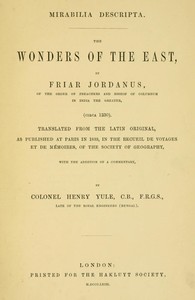
That rainy afternoon, Lithgow’s ink-stained rage at the Dead Sea’s “sulphurous stink” stayed with me—his stubborn need to test the holy places by touch. After closing his book, I found my hand drifting to another shelf. A gentler, older wonder: Mirabilia descripta: The wonders of the East — A Reader’s Guide. My own blunted curiosity simply settled there, among monstrous marvels, without a single argument to offer.
There are no reviews for this eBook.
There are no comments for this eBook.
Reader reflection
How did this book work for you?
Your answers remain private and are stored only in this browser.
Your progress
0
/
10
2
How much did you enjoy the reading experience?
3
Is this a title you would suggest to others?
4
Did the language feel accessible?
5
Did this book create an emotional response?
6
Which part made the strongest impression?
7
How useful were the ideas in this book?
8
How personally connected did you feel to the book?
9
In one sentence, what did you learn?
10