1

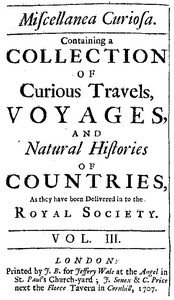
Miscellanea Curiosa, Vol. 3 containing a collection of curious travels, voyages, and natural histories of countries as they have been delivered in to the Royal Society — A Reader’s Guide
(0 User reviews)
85
Project Gutenberg
2015
Not confirmed
Natural history; Voyages and travels -- Early works to 1800; Science -- Early works to 1800
Readers of public-domain and historical texts
Project Gutenberg digital edition
en
Edition facts
Words
112,808
Reading time
491 min
Text sections
32
For Miscellanea Curiosa, Vol. 3 containing a collection of curious travels, voyages, and natural histories of countries as they have been delivered in to the Royal Society — A Reader’s Guide, the stored edition analysis reports 112,808 words, 8 hr 11 min estimated reading time, and 32 detected text sections.
The text analysis averages about 33.9 words per sentence, while the detected sections provide another way to judge how the source is divided.
Project Gutenberg metadata also associates the work with “Natural history,” connecting these edition facts with the source record’s subject description.
Source:
Project Gutenberg record #50229
This 1707 collection of travelogues and natural histories, presented to the Royal Society, juxtaposes empirical observation with speculative conjecture, as seen in accounts of Constantinople, Palmyra, and Chinese writing.
Read the complete public-domain text at its original source.
Read on Project GutenbergThe third volume of Miscellanea Curiosa opens with an advertisement for newly engraved globes, promising celestial constellations “never Engraven upon any Globe.” This commercial note sets the tone for a collection that prizes both discovery and commerce. The volume gathers accounts delivered to the Royal Society, ranging from a journal of a voyage to Constantinople in 1668 to observations on Chinese characters. The excerpts reveal a persistent tension between firsthand report and learned inference: authors frequently qualify their claims with phrases like “I have not yet been able to procure sufficient helps” or “my own Observations … make me think otherwise.” The result is a work that documents not only foreign lands but also the limits of contemporary knowledge.
Uncertainty as a Method
The authors in this volume repeatedly acknowledge gaps in their understanding. In the discussion of Chinese characters, the writer admits that “the Relations I have hitherto met with concerning it, were written by such as did not well understand it.” He then proceeds to offer conjectures based on “such helps as I had,” including printed books with Latin annotations. This cautious approach contrasts with the confident tone of the travel narratives, where distances and directions are given with precision. Yet even there, the reader senses the fragility of the data: the “Distances of the Places” in Eastern Tartary are listed without commentary, as if the numbers themselves were enough. The volume thus becomes a record of what was known, what was guessed, and what remained stubbornly obscure.
Numbers, Marks, and the Puzzle of Writing
A central preoccupation in the excerpts is the decipherment of non-European writing systems. The author analyzing Chinese characters describes a system where “one single stroak signifies one or the first,” and he provides a table of numeral marks. He contrasts this with earlier accounts claiming 120,000 characters, noting that “a Man must be able to remember … at least 8000, or 10000” to be literate. The text oscillates between describing the characters as “the most difficult … piece of Learning” and suggesting that earlier observers may have exaggerated. A similar fascination appears in the letters concerning Persepolis, where “unknown Characters” are drawn and sent to the Royal Society. The volume thus captures an early modern struggle to make sense of alien scripts through comparison with familiar systems like Roman numerals.
Travel as Data Collection
The travel accounts in this volume are less narratives of adventure than compilations of measurable phenomena. The voyage to Constantinople records winds, landmarks, and distances with little personal reflection. The description of Prusa in Bithynia is similarly factual, focusing on geography and architecture. Even the account of Palmyra, though it includes historical observations, is framed as a report “sent by the Reverend Mr. William Hallifax to Dr. Edward Bernard.” The emphasis is on utility: the data could be used to improve maps or to correct ancient geography. This utilitarian bent aligns with the Royal Society’s mission, but it also means that the human dimensions of travel—encounters with local peoples, cultural friction—are largely absent. The volume treats the world as a set of problems to be solved through observation and measurement.
Readers approaching this volume should expect a mosaic of incomplete reports, each reflecting the limits of its author’s experience. The value lies not in definitive answers but in the questions the authors pose: How many Chinese characters exist? What do the inscriptions at Persepolis mean? How accurate are the maps of Tartary? The Miscellanea Curiosa invites us to watch early modern science in the act of gathering, guessing, and sometimes getting it wrong.
Sometimes a book stays with me not for its answers but for its quiet wonder at the world—like that 1707 collection, where travelers described strange lands with such earnest curiosity. It reminded me of how we each carry our own inner landscapes, and The Mountains — Key Ideas to Explore feels like a gentle companion to that same feeling, leaving me content just to sit with its thoughts.
There are no reviews for this eBook.
There are no comments for this eBook.
Reader reflection
What did you think of this book?
Answer a few questions and save a private reflection on this device.
Your progress
0
/
10
2
Was reading this book enjoyable?
3
Is this a title you would suggest to others?
4
What was the reading difficulty like?
5
How well did it match your expectations?
6
Did you relate to its people, ideas, or situations?
7
How clear did the writing feel?
8
Could you see yourself revisiting this book?
9
Which lesson or insight stayed with you?
10