1

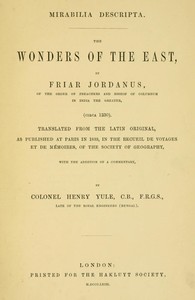
Mirabilia descripta: The wonders of the East — A Reader’s Guide
(0 User reviews)
1196
Project Gutenberg
2021
Not confirmed
Voyages and travels -- Early works to 1800; India -- Description and travel -- Early works to 1800
Readers of public-domain and historical texts
Project Gutenberg digital edition
en
Edition facts
Words
36,504
Reading time
159 min
Text sections
26
For Mirabilia descripta: The wonders of the East — A Reader’s Guide, the stored edition analysis reports 36,504 words, 2 hr 39 min estimated reading time, and 26 detected text sections.
The text analysis averages about 20.5 words per sentence, while the detected sections provide another way to judge how the source is divided.
Project Gutenberg metadata also associates the work with “Voyages and travels -- Early works to 1800,” connecting these edition facts with the source record’s subject description.
Source:
Project Gutenberg record #65474
Friar Jordanus's 14th-century travelogue, translated with commentary by Henry Yule, blends firsthand observation of India with fantastical hearsay, revealing how medieval Europeans reconciled marvels with faith.
Read the complete public-domain text at its original source.
Read on Project GutenbergFriar Jordanus, a Dominican bishop writing around 1330, opens his account with a dedication that immediately establishes the work's dual character: he claims to speak truth of what he has seen, yet freely admits to retailing fables from hearsay. The editor, Colonel Henry Yule, reinforces this tension in his commentary, noting that Jordanus's firsthand marvels—such as winged cats in Malabar—made him credulous of even more extraordinary tales from remoter regions. This framing invites readers to approach the text as both a geographical record and a window into medieval habits of belief.
A Bishop's Twofold Gaze
The opening pages of Mirabilia descripta present Jordanus as a careful observer of natural phenomena—he describes the collection of manna from a shrub, noting the insects that produce it and the method of beating leaves with a crooked stick. Yet alongside such practical detail, he reports that black men in Columbum cut off their own heads before their gods, and that white, fat men are purchased as food in Java. Yule's footnotes often correct or contextualize these claims, pointing out, for instance, that the 'flowing sand' Jordanus may have heard of is actually the Reg-rawán near Istalif. The reader is thus constantly shuttled between the bishop's eyewitness account and the editor's scholarly skepticism.
The Geography of Wonder
Jordanus divides his world into three Indias: Lesser India (Sindh and the coast), Greater India (from Malabar eastward to Cambodia), and India Tertia (eastern Africa). This tripartite scheme, as Yule notes, reflects the Portuguese geographical tradition. Within this framework, the bishop catalogues marvels with a straight face: rats as big as foxes, rocs that carry off elephants, and people with dogs' heads. The commentary repeatedly intervenes to identify real species—the wild ass is Asinus Onager, the lapis lazuli comes from Badakshan—but also to highlight where Jordanus's sources likely erred, as with the puzzling reference to 'Pegua' and bituminous pitch.
Table Manners and Forks
One of the more unexpected observations in the commentary concerns table habits. Yule remarks that Jordanus's description of Persian dining practices—including expectoration into sleeves—suggests that forks were already common in Europe earlier than usually assumed. This aside, buried in a footnote, exemplifies how the editorial apparatus enriches the primary text. The bishop himself notes the dirtiness of Persian meals, but Yule turns this into evidence for material culture history. Readers attentive to such details will find that the commentary often upstages the main narrative in analytical interest.
The Editor's Voice
Henry Yule's commentary is not merely explanatory but argumentative. He defends Jordanus's credibility while acknowledging his credulity, and he frequently corrects the bishop's geography with modern knowledge. For instance, he identifies the 'Ur of the Chaldees' mentioned by Jordanus as likely Urfa, not the town of Ahar near Tabriz. Yule also draws on contemporary travelers like Burnes and Ferrier to confirm or challenge the old reports. This layered structure—medieval text encased in Victorian scholarship—makes the book as much a document of 19th-century orientalism as of 14th-century travel.
To read Mirabilia descripta is to engage with two authors at once: the friar who saw wonders and the colonel who weighed them. Pay attention to the footnotes, where Yule's dry wit and erudition often reshape the meaning of Jordanus's claims. The book rewards those who read slowly, comparing the bishop's marvels with the editor's corrections, and who appreciate that medieval travel writing was as much about the traveler's worldview as about the lands described.
Friar Jordanus trusted what his eyes saw and repeated what his ears heard, and somehow both carried truth. That same gentle, unhurried faith—letting a place keep its mysteries—breathes through A Voyage to Abyssinia, a quieter neighbor on my shelf. A Voyage to Abyssinia — Edition Insights holds that same patient wonder, the sort we old readers recognize like an old friend’s handwriting.
There are no reviews for this eBook.
There are no comments for this eBook.
Reader reflection
What did you think of this book?
Answer a few questions and save a private reflection on this device.
Your progress
0
/
10
2
Did this book hold your interest?
3
Is this a title you would suggest to others?
4
Did the language feel accessible?
5
Did you relate to its people, ideas, or situations?
6
How clear did the writing feel?
7
How valuable was this book for your own interests?
8
Did the book offer a fresh perspective?
9
What is the main idea you are taking away?
10