
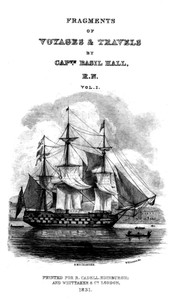
Fragments of voyages and travels, including anecdotes of a naval life — Reading Companion

(11 User reviews)   3403
In Category - Geography
Hall, Basil, 1788-1844 Project Gutenberg 2023 Not confirmed
Voyages and travels -- Juvenile literature Readers of public-domain and historical texts
Project Gutenberg digital edition en

Edition facts

Words 65,990
Reading time 287 min
Text sections 17

This digital edition of Fragments of voyages and travels, including anecdotes of a naval life — Reading Companion is described by source-level measurements including 65,990 words, 4 hr 47 min estimated reading time, and 17 detected text sections.

The text analysis averages about 34.3 words per sentence, while the detected sections provide another way to judge how the source is divided.

Project Gutenberg metadata also associates the work with “Voyages and travels -- Juvenile literature,” connecting these edition facts with the source record’s subject description.

Basil Hall's first volume of naval memoirs for young readers, blending real incidents with moral reflections on discipline, habit, and leadership, structured as episodic fragments from his early sea career.
Share
Editorial Edition Score 4.8/5

Calculated from edition completeness, EPUB availability, text structure and catalogue metadata. Not a user rating.

How this score is calculated
  • Description quality20 pts
  • Title & short description10 pts
  • Source metadata20 pts
  • Text length15 pts
  • Chapters / structure15 pts
  • EPUB file integrity20 pts

Total of 100 points, scaled to a 2.5-5.0 range. Editions with an empty description or a missing EPUB file are not scored.

Edition quality

Read the Text

Various circumstances conspired to give me, very early in life, what is called a taste for the sea. In the first place, I came into the world in the midst of a heavy gale of wind; when such was the violence of the storm, and the beating of the rain, that there were some thoughts of removing the whole party to a less ricketty corner of the old mansion, which shook from top to bottom. So strong, indeed, was the impression made on the imagination of those present, by the roaring of the surf, close at hand, the whistling of the wind in the drenched forest, and the obvious rocking of the house, under the heavy gusts of that memorable gale, that, as soon as I was old enough to understand any thing at all, the association between the events of my future life, and those of my birth-night, began to be sown in my mind. Thus, long before I shipped a pair of trousers, I felt that a salt-water destiny was to be mine; and as every body encouraged me to cherish these early predilections for the sea, I grew up with something of the same kind of certainty of becoming a sailor, as an elder brother does of becoming a country gentleman, from his knowing—‘for quickly comes such knowledge’—that the estate is entailed upon him.

The holydays, also, which released me from the irksome confinement of the High School of Edinburgh, were passed in the country, on a part of the rugged sea-coast of Scotland, peculiarly calculated to foster nautical propensities. During the weary months which preceded and followed these six delicious weeks of liberty, my thoughts, instead of being devoted to the comprehension of abstract rules of grammar, which it was our worthy preceptor’s sole object in life to drive into us, invariably strayed back to the picturesque and iron-bound shore, as it is happily termed in naval language, along which I was wont to ramble in full enjoyment during these holydays.

So incessantly, indeed, was the contrast presented to my imagination, between the cramped routine of school discipline, and the glorious freedom of the sea-beach, that I took little or no interest even in the games which filled up the play-hours of the other boys; and, from dwelling upon these thoughts day and night, I became so gloomy and wretched, that the bare recollection of my feelings at that period often makes me shudder, though more than thirty busy years have since passed over my head. The master of our class was as excellent a man, I believe, as could be; but he would have deemed it a shocking crime against his calling—which he very naturally considered the first on earth—to have allowed that any one boy possessed a particle more of feeling, or was conscious of more independence of thought, than his companions. Still less could he understand that any boy should pretend to have aspirations and wild fancies—dreams he called them—the object of which lay far beyond the boundary walls of the play-ground. Accordingly, I dragged on a tolerably profitless and painful existence for several years; though, perhaps, with a little management, this period might have been rendered not only useful, but happy.

Once only, during my continuance in this Limbo, as the Spaniards call the Purgatory of Children, I was addressed in a very kind manner by the head master, though a severe personage in his way, as far as regarded the use of the formidable strap, or taws, which in Scotland supply the place of the wholesome birch of English seminaries. He took me on one side, and said, in a tone so unusual in the despotic government of schools in those days, that it made me start,—“How comes it, little fellow, that you are always so gloomy; and that you never play as the rest do, but look for ever as if some misfortune had befallen you?”

I answered, ‘that the confinement of the school was much too great, and that I could not bear being always treated as if I had no feelings or peculiar wishes worthy of separate consideration. That it was not the number of hours’ confinement I complained of, but the awkward selection of the periods.’ “Let me, sir,” I said, “but choose the time for study, and I will cheerfully work even much longer. At present, the day is totally cut up and destroyed.”

He smiled, patted me on the head, and said the hours and discipline could not be changed, merely to suit the fantastic taste of one boy. I knew this well enough already; in fact, I was not so absurd as to suppose that a public school could be maintained on my visionary principles, or that any rules could be established for their government but such as took account of average abilities, and made allowance for an ordinary share of feeling and patience. Whether or not my quantum of sensibility were needlessly great, is of little consequence: it certainly was so different from that of my companions, that it completely prevented my profiting, in the mean time, by the opportunities of this school, and drove me to rest my only prospect of happiness in getting away from its thraldom.

Certain very troublesome misgivings, also, as to the future, came across my juvenile thoughts about this epoch; especially as to the probabilities of happiness in that wide world of freedom for which my soul panted, and of which I knew nothing, except by description. I happened, one day, to get hold of Gray’s Ode on a distant Prospect of Eton College,—a poem fraught, it is true, with images of the highest possible beauty, both of thought and of expression, but most of which are certainly far better calculated to beget despondency than hope, by teaching that school days are unavoidably happier than those of after-life.

What the ‘march of intellect’ may have done lately to remedy this matter, I cannot say; but in my time, and at the particular school alluded to, the season of boyhood was, to me at least, any thing but a happy one; and I well remember, after reading the poem in question, exclaiming, in a state of great despair, “If it is certain that my future life is to be more wretched than this, which is now so full of misery, what, alas! is existence worth?”

In this terrified frame of mind, I dived into various other works, but, to my sorrow, very seldom met with anything of a more consolatory nature. Nor was it till many years’ trial of the wear and tear of actual life, that I came to learn the fallacy of most of these assertions respecting the comparative happiness of school; and to feel assured that the whole, or nearly the whole matter, lies essentially with ourselves, since, in any situation in life, the amount of our happiness will be found to bear, in the long run, a pretty exact ratio to the heartiness with which we perform our duty. Whereas Gray’s Ode, Young’s Night Thoughts, and other sombre productions, too often thrust into the hands of young people, would almost seem to inculcate the notion that the most virtuous persons are the least happy, and that life is necessarily filled with care and remorse, instead of being, as it really is, to those who choose to make it so, a scene of high enjoyment—not, indeed, one of unmixed enjoyment, but one in which the pleasures generally far outweigh the sorrows. It has, accordingly, always seemed to me a libel on our nature, and a perverse misapplication of the gifts of Providence, to consider that the earliest days of life must of course be the happiest. It may do very well, in poetical fiction, to talk of childhood being the ‘sunshine of the breast;’ but surely the true, broad daylight of life, not poetically, but practically speaking, is to be found at a later period, when the faculties are far more matured, and the will is left free.

Be all this, however, as it may, I never lost a minute in hurrying away from school, the instant our examinations were ended. At these periodical trials, it may be well supposed, I never cut any great figure; for, I contented myself with trying to keep a little above the middle, partly because some boys sat thereabouts to whom I was attached, anti partly because the particular bench alluded to was near the fire. As soon as the term of imprisonment was over, I flew to the coach-office, and never felt perfectly satisfied that all was right and safe, till fairly seated on the top, by the side of my friend the guard, and bowling along the high road. On reaching the country, the first object always was to hunt out some of the fishermen on the shore, who readily engaged to give me a row next morning. After a sleepless night of anticipated delights, I commonly found myself, at sunrise, in a fishing-boat, half a league from the coast, surrounded by congenial spirits—fellows who had no idea of grammar—and who were willing, either from bribery, or from motives of professional sympathy, to consider me as somebody, and not to reckon me as a mere zero, serving no other purpose but to augment the numbers of a school, without having any value in myself.

At all events, these hardy boatmen were so much amused with my enthusiasm about their art, that they took great pleasure in feeding my young fancy with tales of nautical dangers and hardships, the joyous excitement of which placed the dull drudgery of syntax in sad contrast. On these expeditions, however, I was always wofully sea-sick; for the boats, or cobbles, as they are called, were not altogether so tidy as a man-of-war’s gig; besides which, they generally enclosed a due allowance of bilge water, and decayed remnants of forgotten fish. So that my taste for the sea had often tough work to hold its ground, against the deranged action of the stomach; and it must be owned that I often leaped on shore again, to the enjoyment of steady footing and an atmosphere less fishified, with a half-uttered vow at my lips that I would never tempt the ocean more.

This slight infidelity to my beloved element, however, was always very transient, as it seldom lasted longer than the time it cost to climb the high, steep bank, which guarded the coast. From this elevation, the view extended far up the Firth of Forth on one hand, with many a mountain lying beyond it; right out into the German Ocean in front; while the scene was bounded on the right, or eastern side, by the noble promontory called Fast Castle, better known as the Wolf’s Crag of the Waverley Novels. To my young fancy this seemed the grandest of all landscapes—and still, after I have rambled for more than a quarter of a century over the earth’s surface, and made personal acquaintance with some of the sublimest works of nature, my opinion of the beautiful scenery in question is not changed, otherwise than by increased admiration. Indeed, it will often require much time, and more extended means of comparison, as well as the assistance of just conceptions of what is really meant by the great and beautiful in nature, which spring from experience alone, before we can fairly estimate the advantages which frequently lie at our very doors. This will apply, perhaps, to other things besides scenery—but it is with that alone I have to do just now—and certainly few things can be imagined more brilliant than the view from the part of the coast in question. For the sea at that point being a great commercial thoroughfare, is generally studded over with vessels of various sizes and descriptions, and, I may add, of colours. For what the lights and shades of heaven do not perform in this respect, the seamen do for themselves, by tanning their sails, and painting the ships of many different hues. As these vessels drifted past, and dropped, one by one, out of sight, beyond the horizon, I felt the most eager desire to follow their wanderings into those wide seas, about which I had so often read—where the land is lost sight of for months together, and where every evening brings fresh stars into view, and every bird and fish, as well as every breath of air, indicates another climate, and almost another world.

In the meantime, however, my operations in nautical affairs were necessarily limited to the horse pond, upon which, by the assistance of an obliging carpenter lad, I managed to make the first fair trial of that element with which, in after life, it was my happy lot to become so familiar. Our vessel consisted of two or three rough logs, filched from the farm-yard, and sundry planks nailed or lashed across them. A mast was readily obtained by the abstraction of a bar from the nearest paling. But considerable difficulty arose as to the sail; for canvass was a material much beyond our finances or influence. At length my ingenious companion—who, by the way, distinguished himself in after-life as a ship-builder—suggested the idea of employing one of the mats used by the gardener to protect his plants from the frost. Thus, step by step, our gallant vessel was at length rigged out; and on the second day of our labours, every thing being ready, and the wind fair, we started from one end of this inland sea, and, after a prosperous voyage of about ten minutes, by ‘God’s grace’—to use the quaint language still printed in bills of lading—more than by any skill of our own—we reached the other extremity, without any serious disaster.

The pleasure which this primitive voyage inspired, has never since been much exceeded. It was the first unalloyed happiness I had ever experienced, and at once opened up a new prospect of hope and resolution, which rendered the weary load of school existence somewhat less intolerable than it had been before. It also gave me a foretaste of the joys of enterprise, and independent command, which, in their turn, called up innumerable visions of successful resource, surmounted difficulties, and all the demi-savage delights of such a life as that of Robinson Crusoe, with the additional advantage of that great adventurer’s experience.

Little did I then think, and, in fact, it was nearly impossible I should reasonably think, that the realities of life could ever reach these imaginary conceptions. And yet I have lived to experience that, sanguine as I then was, these anticipations fell much short of the glorious reality which is almost every where to be met with. Indeed, I may say, with perfect truth, that in all these voyages and travels, I have generally found things more curious, and more interesting, in all respects, than I had looked for—or, if the career of curiosity has at any time been checked, it has only been followed by a more ardent pursuit, and ultimately by still higher rewards.

This process of feeding the curiosity, was well enough exemplified by a series of very exciting, though often painful and seemingly discouraging, incidents that occurred every year on the coast already mentioned, as forming the scene where I passed the holydays. Ten leagues, or thirty geographical miles, due north of the house in which I was born, lies the Bell Rock, just off the mouth of the Tay, and close to the northern side of the great estuary called the Firth of Forth. At the time I am speaking of, this rock was justly considered one of the most formidable dangers that the navigators of those seas had to encounter; for its head was merged under the surface during greater part of the tide, and at no time did it make any shew above the water. There was nothing to be done, therefore, but to keep well clear of the mischief, or, as seamen express themselves, to give the rock a wide birth. Ships, accordingly, bound for the Forth, in their constant terror of this ugly reef, were not content with giving it ten or even twenty miles of elbow room, but must needs edge off a little more to the south, so as to hug the shore, in such a way, that, when the wind chopped round to the northward, as it often did, these overcautious navigators were apt to get embayed in a deep bight to the westward of Fast Castle. If the breeze freshened before they could work out, they paid dearly for their apprehensions of the Bell Rock, by driving upon ledges fully as sharp, and far more extensive and inevitable. Thus, at that time, from three to four, and sometimes half a dozen vessels used to be wrecked every winter, within a mile or two of our very door.

Perhaps there are few more exciting spectacles than a vessel stranded on a lee-shore—and especially such a shore—which is fringed with reefs extending far out, and offering no spot for shelter. The hapless ship lies dismasted, bilged, and beat about by the waves, with her despairing crew clinging to the wreck, or to the shrouds, and uttering cries totally inaudible in the roar of the sea—while at each successive dash of the breakers, the number of the survivors is thinned, till, at length, they all disappear—the gallant bark goes to pieces—and the coast, for a league on either side, is strewed with broken planks, masts, boxes, and ruined portions of the goodly cargo, with which, a few hours before, she was securely freighted, and dancing merrily over the waters.

But it is the greatest of all mistakes to suppose that the actual contemplation of such disasters, still less the description of hardships, has any tendency to divert a young mind from following its original bent, towards a profession of such varied and high excitement as that of the sea. At all events, the effect of each succeeding shipwreck I witnessed, was only to stimulate me more and more to pursue the object of all my thoughts, waking or dreaming.

I can recollect, however, being conscious of a feeling of awe, approaching at times to dread, as I saw the waves curling themselves over these devoted vessels, and gradually tearing them to pieces as the tide advanced. But still there was always more of confidence and pleasure in the prospect which my mind’s eye conjured up to itself beyond these stirring adventures. To this day there is told a traditional story amongst our fishermen, of my having once contributed to save a ship’s crew, by engaging some country people to transport a boat from a distance, across the hills, in a cart. The account farther sets forth, that I had only a few halfpence in my pocket; and that when these proved insufficient to induce the carter to go out of his way, I stoutly asserted I had authority from my father to offer five pounds for any such assistance. Upon this pledge, the cart was freighted with its unwonted cargo, and the boat was brought in time to the spot. I have no recollection whatsoever of this incident; but something of the kind may possibly have occurred, or, more probably, may have been merely talked of amongst the fishermen, my great patrons and admirers. These things, by making me feel not so utterly useless in the world, as I was made to appear at school, must have united me by still stronger ties to the animating profession to which I grew up, apparently as a matter of course.

Basil Hall opens his first volume of Fragments of Voyages and Travels with a striking personal detail: he was born during a heavy gale, the old mansion shaking so violently that the party considered moving to a less rickety corner. This anecdote immediately establishes the book’s method—concrete, often dramatic scenes from a naval life, each offered as a self-contained fragment rather than a continuous narrative. Hall addresses his work chiefly to young persons, but he does not simplify his material; instead, he weaves moral commentary into the action, advising his readers to cultivate the habit of being pleased rather than sharp-sighted in discovering what is disagreeable. The result is a hybrid of memoir, conduct manual, and sea story, held together by the author’s firm, conversational voice.

Fragments as a Structural Principle

The title’s word “fragments” is not mere modesty. Hall organizes his material into discrete chapters with titles such as “Early Predilections,” “First Going Afloat,” and “Specimens of Cock-Pit Discipline,” each presenting a single episode or theme. The table of contents lists eleven chapters in Volume I, each a self-contained unit. This structure allows Hall to move between scenes without the burden of a continuous plot—a practical choice for a work intended for young readers who might dip in and out. Yet the fragments are not random; they trace a rough chronological arc from childhood fascination with the sea to early experiences as a midshipman. The episodic form also mirrors the nature of naval life itself, where duty is broken into watches, ports of call, and distinct commands.

Recurring Images of Storm and Discipline

From the opening gale to later descriptions of fog and blockade, weather functions as both setting and metaphor. Hall uses storms to test character and to illustrate his central theme: that moral discipline, like a ship’s machinery, requires “a due regulation of that elasticity.” In the preface he warns young readers not to puzzle over difficult passages, but the text itself repeatedly returns to the image of the ship as a moral engine, where “the different component parts of the machine are so closely fitted to one another.” This mechanical analogy recurs alongside natural imagery, creating a tension between the unpredictable sea and the ordered world of the vessel. Hall’s advice to acquire “the habit of being pleased” is grounded in these concrete situations, not abstract philosophy.

Movement Between Shore and Ship

Hall’s narrative moves fluidly between domestic settings and the deck of a man-of-war. The first chapter, “Early Predilections,” describes his childhood home and the storm that marked his birth, while subsequent chapters shift abruptly to the cockpit, the mast-head, and the quarterdeck. This back-and-forth creates a rhythm of contrast: the safety of the old mansion versus the violence of the gale; the comfort of home versus the rigors of naval discipline. Hall uses these transitions to highlight the differences between life on shore and afloat, but also to show how principles learned in one sphere apply to the other. His advice about avoiding a “growling” temper is explicitly tied to the confined society of a ship, where “the distinctions of rank are strongly marked” and an officer’s authority is exactly determined by law and usage.

The Authorial Voice and Its Audience

Hall addresses his “Young Friends” directly in the preface and throughout the text, but his tone is that of an experienced officer offering counsel, not a schoolmaster lecturing. He admits that it is “not a settled point” whether young readers prefer true stories or fiction, then asserts that all his incidents are real. This claim of authenticity is central to his authority. He also limits his advice to opinions that “might have proved useful to himself” at some stage of his own professional life, a gesture of humility that softens the didacticism. The voice is confident but not pompous, and it occasionally shifts into general reflection, as when he discusses how men are judged by “the reflected light which is sent back from the objects surrounding them.” These philosophical asides are woven into the narrative rather than separated into lessons.

Readers approaching this volume should expect not a continuous autobiography but a series of vivid, morally charged episodes. Hall’s fragments reward attention to recurring images—storms, discipline, the contrast between shore and ship—and to the way he moves between concrete anecdote and general reflection. The book is best read not as a history but as a crafted performance of naval character, designed to instruct by example. The remaining two volumes continue the pattern, but this first volume establishes the method and the voice that sustain the whole work.

That grey afternoon, Hall’s fragments felt like listening to rain on canvas—each anecdote a small discipline, a habit of attention formed almost without noticing. Later, I found myself wondering about the places his voyages only skirted, and pulled down an old volume on Brazil. It had the same unhurried patience, the same quiet weighing of strange customs against familiar ones. One book simply handed me to the next, like a handoff on a long watch: Travels in the interior of Brazil with notices on its climate, agriculture, commerce, population, mines, manners, and customs: and a particular account of the gold — Background and Themes.

Scarlett Hernandez
1 month ago

Wyatt Walker
3 weeks ago

William Carter
1 week ago

Sophia Nguyen
3 weeks ago

Charlotte Sanchez
2 weeks ago

4.5
4.5 out of 5 (11 User reviews )

Add a Review

Your Rating *
There are no comments for this eBook.

Reader reflection

Your personal reading reflection

Build a private reading journal entry for this title.

Your progress 0 / 10
1

What is your current status with this title?

2

Was reading this book enjoyable?

3

How likely are you to recommend this book?

4

How easy was the book to follow?

Related eBooks