1

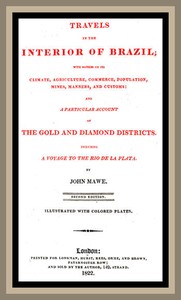
Travels in the interior of Brazil with notices on its climate, agriculture, commerce, population, mines, manners, and customs: and a particular account of the gold — Background and Themes
(0 User reviews)
1787
Project Gutenberg
2015
Not confirmed
Brazil -- Description and travel; Gold mines and mining -- Brazil; Diamond mines and mining -- Brazil; Brazil -- Economic conditions -- 19th century
Readers of public-domain and historical texts
Project Gutenberg digital edition
en
Edition facts
Words
127,717
Reading time
556 min
Text sections
30
The catalog record for Travels in the interior of Brazil with notices on its climate, agriculture, commerce, population, mines, manners, and customs: and a particular account of the gold — Background and Themes provides practical reading context through 127,717 words, 9 hr 16 min estimated reading time, and 30 detected text sections.
The text analysis averages about 28.1 words per sentence, while the detected sections provide another way to judge how the source is divided.
Project Gutenberg metadata also associates the work with “Brazil -- Description and travel,” connecting these edition facts with the source record’s subject description.
Source:
Project Gutenberg record #50653
John Mawe's 1822 travelogue moves through Brazil's interior with a geologist's eye, tracking gold and diamond districts through layered descriptions of terrain, abandoned washings, and the social fabric of mining settlements.
Read the complete public-domain text at its original source.
Read on Project GutenbergJohn Mawe's narrative is built on a series of precise geographical movements, each stage marked by changes in elevation, river crossings, and the visible scars of gold extraction. The text repeatedly notes the 'vestiges of having been formerly washed for gold' that line roadsides and riverbanks, creating a landscape where economic history is literally written into the soil. Mawe's journey is not merely a route but a descent into a region shaped by mineral wealth and its aftermath.
Movement Through a Layered Landscape
The journey proceeds in measured stages, each paragraph advancing the party from one named location to the next. Mawe records distances, elevations, and the condition of roads with the precision of a surveyor. The descent from 'a very high and confined situation, between two perpendicular mountains' to the Rio do Carmo is typical: the narrative moves from a bird's-eye view to the river's edge, then along its course through 'fine sloping hills and fertile plains.' This vertical and horizontal motion structures the account, giving readers a sense of traversing a country where every ridge and valley has a history of mining.
Recurring Signs of Abandonment and Neglect
Throughout the excerpts, Mawe observes that the landscape bears 'vestiges of having been formerly washed for gold' and that the road-side 'exhibited similar remains.' At Lavras Velhas, the owner struggles to maintain himself 'with thirty or forty negroes,' and the establishment shows 'a pitiful spectacle of neglect, indifference, and sloth.' The contrast between past wealth and present decay is a persistent motif. Mawe expresses surprise at 'no good dwelling-houses in a district which formerly produced so much wealth,' and is told that early miners 'seldom remained long on the same spot.' These observations suggest a pattern of extraction followed by abandonment, a cycle that shapes both the land and its inhabitants.
The Interplay of Natural and Human Geography
Mawe's descriptions weave together natural features and human interventions. Rivers are 'extremely turbid, on account of the mud brought from the gold-washings along the banks.' The weather is read through signs: 'exceedingly large worms, stretched motionless on the road' are taken as 'sure signs of wet weather.' The party ascends a high hill and is 'immerged for about an hour in a cloud,' a moment that blends physical geography with sensory experience. These details ground the narrative in a specific environment where the natural world is both a resource and a constant presence, its conditions affecting travel and work alike.
Social Fabric of the Mining Districts
The text introduces a network of landowners, stewards, judges, and settlers. Senhor Mathias Barboza, who 'took up these lands and drove the Aborigines from them,' is a figure of colonial enterprise whose daughter inherits his wealth and marries into Portuguese nobility. The Conde de Linhares's steward provides mules, and Dr. Lucas, the Judge, 'obligingly ordered every necessary to be provided.' These interactions reveal a society structured by patronage and officialdom, where travel depends on local connections. The mention of 'thirty or forty negroes' working a struggling estate points to the enslaved labor force that underpins the mining economy, though Mawe does not elaborate on their conditions.
Readers attentive to the interplay of observation and inference will find that Mawe's account offers more than a route through Brazil; it documents a landscape in transition, where the marks of extraction are as prominent as the natural features. The narrative's strength lies in its accumulation of detail—the turbid rivers, the neglected estates, the fleeting encounters with local officials—that together evoke a region defined by its mineral resources and the human systems built to exploit them.
Reading Mawe’s account of Brazil’s abandoned gold washings, I felt the quiet weight of places once bustling, now still. That same hush surfaced in The Naturalist in Nicaragua — Context and Discussion, where every trail holds traces of earlier footsteps. Both books feel like conversations with landscapes that remember more than they say.
There are no reviews for this eBook.
There are no comments for this eBook.
Reader reflection
What did you think of this book?
Answer a few questions and save a private reflection on this device.
Your progress
0
/
10
2
What was your overall reaction to the book?
3
Would you pass this book on to a friend?
4
How demanding did the text feel?
5
What was the strongest part of the book?
6
Would a second reading be valuable?
7
How would you rate its originality?
8
How did the pace of the book feel?
9
Which lesson or insight stayed with you?
10