1

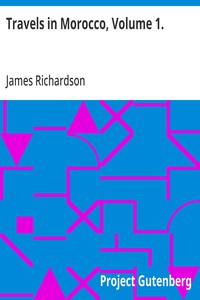
Travels in Morocco, Volume 2. — Story, Setting & Ideas
(0 User reviews)
2361
Project Gutenberg
2003
Not confirmed
Morocco -- Description and travel
Readers of public-domain and historical texts
Project Gutenberg digital edition
en
Edition facts
Words
55,765
Reading time
243 min
Text sections
5
This digital edition of Travels in Morocco, Volume 2. — Story, Setting & Ideas is described by source-level measurements including 55,765 words, 4 hr 3 min estimated reading time, and 5 detected text sections.
The text analysis averages about 23.1 words per sentence, while the detected sections provide another way to judge how the source is divided.
Project Gutenberg metadata also associates the work with “Morocco -- Description and travel,” connecting these edition facts with the source record’s subject description.
Source:
Project Gutenberg record #10356
James Richardson's second volume on Morocco blends travelogue with statistical analysis, critiquing prior population estimates while detailing cities, tribes, and the Berber-Arab divide. His narrative voice shifts from ethnographic observation to scholarly correction, offering a grounded perspective on 19th-century North Africa.
Read the complete public-domain text at its original source.
Read on Project GutenbergJames Richardson's second volume of Travels in Morocco opens not with a traveler's anecdote but with a chapter on Mogador Jewesses and disputes between Jew and Moor, immediately signaling his interest in social dynamics. The narrative voice is that of a careful observer who frequently pauses to correct earlier writers. In the chapter on population, he dismisses Jackson's estimate of fifteen million as “beyond all rhyme or reason” and offers his own adjusted figures, revealing a methodical, skeptical temperament. Richardson's prose moves between vivid scene-setting—such as the “melancholy scenes” of Jewish life—and dry statistical analysis, creating a distinctive rhythm that mirrors his dual role as traveler and scholar.
Voice of the Critical Traveler
Richardson's narrative voice is notably self-aware and corrective. He does not simply describe; he evaluates. When discussing the population of Morocco, he quotes Monsieur E. Renou's assertion that no accurate statistics exist except by comparison with Algeria, then adds his own agreement “from the personal experience I had in Morocco.” This first-person authority is tempered by humility: he admits that “our geography of the interior of Morocco, especially in the South, is still very obscure.” His tone is that of a scholar in the field, not a romantic adventurer. He uses phrases like “I am quite sure there are no Touaricks in the Empire of Morocco” to directly challenge earlier classifications, showing a willingness to dispute established authorities. This critical edge gives the text a persuasive, almost argumentative energy, as if Richardson is conducting a running debate with his predecessors.
Structure and the Shift to Enumeration
The book's structure alternates between narrative chapters and dense lists of towns, populations, and resources. Chapter IV, for instance, is a catalog of coastal cities—Melilla, Tetouan, Salee—each given a brief description. This enumeration is not dry; it serves a purpose. Richardson explains that his “object, in the above enumeration, has been simply to give the reader a proximate estimate of the population and resources of this country.” He is aware of the limits of such lists, noting that “the names of the towns and villages of the South, so frequently beginning and ending with T., sufficiently indicate the preponderance of the Berber population.” The pace slows in these sections, demanding patience from the reader, but the accumulation of detail builds a concrete sense of the empire's geography. The shift from lively anecdote to statistical table is a deliberate rhetorical move, grounding the travel narrative in empirical data.
Recurring Details: Berbers, Arabs, and the Atlas
Throughout the excerpts, Richardson returns to the distinction between Berbers and Arabs. He corrects the “great error of writers” who overcount Arabs, emphasizing that the aboriginal Amazirghs (Berbers) are more numerous. This theme appears in the chapter on the Atlas, where he discusses the Jews of the Atlas and their religion, and again in the population breakdown where he classifies “Amazirghs, Berbers, and Touaricks” separately. He also notes the geographical marker of Berber presence: place names beginning or ending with “T.” The Atlas mountains themselves are a recurring setting, described as “Derem, or the Atlas chain” in Chapter III, and linked to natural products like the Argan tree. These details are not merely decorative; they form a pattern of attention to ethnic and environmental specificity that defines Richardson's approach. He is less interested in dramatic events than in the steady accumulation of observable facts about the land and its people.
Readers approaching this volume should expect a work that moves between the immediacy of travel and the detachment of a statistical survey. Richardson's voice is that of a guide who questions his own sources, making the text as much about the challenges of knowing Morocco as about Morocco itself. Pay attention to his asides and corrections—they reveal the mind of a writer deeply engaged with the limits of his own knowledge.
There’s something melancholy in how Richardson tallies the tribes, correcting old numbers with a patient hand, as if pinning down a people who’d rather drift. It made me think of another worn volume on my shelf, A General History and Collection of Voyages and Travels — Volume 13 — Context and Discussion, where every mile feels similarly measured and mourned. Both feel less like travel than like listening for footsteps.
There are no reviews for this eBook.
There are no comments for this eBook.
Reader reflection
How will you remember this book?
Save your reaction, strongest insight, and memorable passage.
Your progress
0
/
10
2
Did this book hold your interest?
3
Is this a title you would suggest to others?
4
Did the language feel accessible?
5
Was the book moving at the right speed?
6
Was the book easy to understand?
7
Did the book give you something worth debating?
8
How strong was your personal connection to the text?
9
In one sentence, what did you learn?
10