1

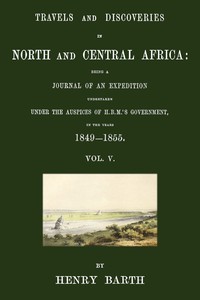
Travels and discoveries in North and Central Africa, Vol. 5 (of 5) — Inside the Classic
(0 User reviews)
1538
Project Gutenberg
2025
Not confirmed
Africa, Central -- Description and travel; Africa, North -- Description and travel
Readers of public-domain and historical texts
Project Gutenberg digital edition
en
Edition facts
Words
201,339
Reading time
876 min
Text sections
28
For Travels and discoveries in North and Central Africa, Vol. 5 (of 5) — Inside the Classic, the stored edition analysis reports 201,339 words, 14 hr 36 min estimated reading time, and 28 detected text sections.
The text analysis averages about 16.7 words per sentence, while the detected sections provide another way to judge how the source is divided.
Project Gutenberg metadata also associates the work with “Africa, Central -- Description and travel,” connecting these edition facts with the source record’s subject description.
Source:
Project Gutenberg record #76320
Heinrich Barth's fifth volume details his 1854-55 sojourn in Timbúktu and Kúkawa, blending diary entries with commercial analysis. The narrative moves between tense political negotiations, river observations, and reflections on lost supplies, revealing the precarious logistics of 19th-century African exploration.
Read the complete public-domain text at its original source.
Read on Project GutenbergHeinrich Barth’s fifth volume opens with a striking anomaly: the Niger River rising in January, a phenomenon he explains through careful observation of local hydrology. This blend of natural detail and political tension sets the tone for a narrative that shuttles between the material and the diplomatic. Barth’s diary entries, structured as dated chapters, record not only his own movements but also the machinations of merchants, the arrival of messengers, and the shifting allegiances of local rulers. The reader is plunged into a world where a loan of 200 dollars, a plundered box of ironware, or a gift of fourteen oxen can alter the course of an expedition.
The River as a Narrative Marker
The Niger’s “anomalous rising” in January 1854 is more than a meteorological curiosity; it becomes a structural pivot in Barth’s account. He devotes several pages to explaining the phenomenon, linking it to the river’s commercial importance and the timing of caravans. This attention to natural cycles recurs throughout the volume: the subsiding waters in February, the rainy days that delay departure, and the seasonal rhythms that govern trade in salt, gold, and gúro nuts. Barth’s prose moves from precise measurement to broader inference, treating the river as both a physical obstacle and a source of order in a landscape of political flux.
Diplomacy and Disappointment
Barth’s interactions with local authorities are marked by a constant negotiation of trust and resources. In Kúkawa, he presents a gift worth “about eight pounds sterling” to the Sheikh, only to find himself entangled in a dispute over plundered goods. The courtier Díggama emerges as a particular antagonist, while Yusuf, the Sheikh’s brother, is described as “intelligent and straightforward.” Barth’s strategy—making presents, explaining English intentions, and appealing to conscience—reveals the fragile basis of European influence. The narrative captures the tension between official diplomacy and the personal rivalries that could derail an expedition.
The Weight of Supplies and Letters
Material scarcity pervades the volume. Barth discovers that cash and ironware deposited in Zínder have been plundered, and merchandise transported to Kúkawa has been “abstracted.” He is forced to borrow from a Fezzáni merchant and to examine the remnants of Mr. Vogel’s supplies. Amid these losses, a packet of letters dating to December 1851 provides unexpected pleasure. The contrast between the fragility of physical goods and the endurance of written correspondence is a quiet motif. Barth’s Christmas gift of fourteen oxen to the capital’s inhabitants—rich and poor, blind and fókara—serves both as a vow fulfilled and a strategic investment in goodwill.
Movement Between Towns and Tents
The volume’s geography is defined by constant movement: from Timbúktu to the tents of the Awelímmiden, from Kúkawa to the Ródha meeting ground. Barth records the “warlike nightly manœuvres” of the Tábu army, the “political meeting at the Ródha,” and the “consultation of the Brothers.” These shifts in location are not merely logistical; they correspond to shifts in authority and risk. The narrative structure mirrors this restlessness, with chapters that begin in one setting and end in another. Barth’s eye for detail—the arrival of Sídi Mohammed, the unlucky fate of a parcel, the celebration of the Sebúwa—anchors the reader in a world where every journey is uncertain.
Readers approaching this volume should attend to the interplay between Barth’s diary entries and his analytical asides. The text rewards those who track the recurrence of names, debts, and natural phenomena across chapters. Barth’s voice is that of a meticulous observer who is also a participant in the events he records—a combination that gives the narrative both immediacy and depth. The volume stands as a record of endurance, but also as a document of the fragile networks that made 19th-century exploration possible.
Reading Barth’s account of waiting for lost supplies in Kúkawa, I felt the strange weight of a journey dependent on things that might never arrive. It reminded me of those later Arctic narratives, where the same patient dread hangs over every plan. There’s a quiet kinship in Modern Whaling & Bear-Hunting A record of present-day whaling with up-to-date appliances in many parts of the world, and of bear and seal hunting in the Arctic regions — Key Ideas to Explore, though the tools differ—the waiting does not.
There are no reviews for this eBook.
There are no comments for this eBook.
Reader reflection
How will you remember this book?
Save your reaction, strongest insight, and memorable passage.
Your progress
0
/
10
2
How much did you enjoy the reading experience?
3
How likely are you to recommend this book?
4
What was the reading difficulty like?
5
How useful did the reading feel?
6
Did you relate to its people, ideas, or situations?
7
Did the book deliver what you hoped for?
8
How original did the book feel?
9
What did this book teach you most?
10