1

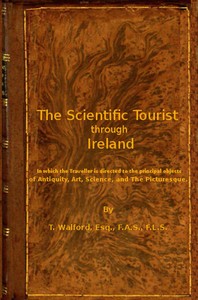
The Scientific Tourist through Ireland in which the traveller is directed to the principal objects of antiquity, art, science & the picturesque — Key Ideas to Explore
(0 User reviews)
3074
Project Gutenberg
2015
Not confirmed
Ireland -- Description and travel
Readers of public-domain and historical texts
Project Gutenberg digital edition
en
Edition facts
Words
79,040
Reading time
344 min
Text sections
9
The source record for The Scientific Tourist through Ireland in which the traveller is directed to the principal objects of antiquity, art, science & the picturesque — Key Ideas to Explore measures this digital text at 79,040 words, 5 hr 44 min estimated reading time, and 9 detected text sections.
The text analysis averages about 17.9 words per sentence, while the detected sections provide another way to judge how the source is divided.
Project Gutenberg metadata also associates the work with “Ireland -- Description and travel,” connecting these edition facts with the source record’s subject description.
Source:
Project Gutenberg record #48757
Thomas Walford's 1818 guide directs the scientific tourist to Ireland's antiquities, geology, and picturesque landscapes, blending practical travel advice with detailed observations on round towers, cromlechs, and coastal formations.
Read the complete public-domain text at its original source.
Read on Project GutenbergThomas Walford's 1818 guidebook addresses the 'casual six-weeks visitant' who wishes to explore Ireland's 'most important and curious specimens of nature and art' without excessive inconvenience. The work is structured around counties, each entry listing categories such as 'Antiquities,' 'Round Towers,' and 'Mineralogy,' with a glossary and comparative mountain heights appended. Walford explicitly aims to counter complaints about Irish travel by offering methodical selection of sights, yet he acknowledges that the tourist 'must learn to suffer petty vexations, privations, and delays.'
The Guidebook's Hybrid Genre
Walford's volume blends antiquarian cataloguing with practical itinerary advice, a combination visible in the table of contents where 'Druidical Monuments' and 'Cromlechs' sit alongside 'Travelling' and 'Temperature.' The preface frames the work as an 'adjunct' to earlier Scientific Tourist volumes on England, Wales, and Scotland, implying a systematic approach. Yet the excerpts reveal a tension: the author includes detailed measurements of round towers and a glossary of terms, but also warns that Killarney's sublime views require ascending heights—a task he deems feasible 'even to the most timid' via gullies hollowed by winter torrents. This juxtaposition of scholarly precision and practical reassurance defines the book's character.
Practicalities and Local Friction
Walford does not shy from noting the inconveniences of Irish travel. At Killarney, he reports that guides 'will force themselves upon him to a much greater extent than is necessary,' and that boatmen 'always expect more' than Lord Kenmare's regulated rates. The tourist must carry provisions and expect to feed his guides or pay extra. Such details ground the sublime landscapes in everyday negotiation. Similarly, at Tarbert, the inn is 'good' and the church has a 'handsome steeple,' but the nearby Devil's Castle cliff is 'inaccessible to all but the winged creation,' while the shore below offers 'romantic caverns formed by the dashing of the waves.' The guide oscillates between the mundane and the majestic.
Geological and Antiquarian Specifics
Walford's scientific eye seizes on particular formations: at Ardtully, he notes 'a geological curiosity of two rocks, one limestone upon a gritty soil, the other grit upon a limestone basis.' He records the Fairy Rock at Kilgarvan with 'impressions of human feet,' and describes Beal Castle as the site of 'a horrid murder detailed in the Pacata Hibernia.' The book's frontispiece depicts 'Antiquities in Ireland,' and the contents list includes 'Ogham Inscriptions' and 'Cairns.' These specifics, drawn from the excerpts, show a writer attentive to both natural history and local lore, though the full extent of his coverage cannot be assessed from the sample alone.
Readers approaching this guide should expect a work that is part reference manual, part travelogue, and part practical handbook. Walford's voice is that of an informed compiler rather than a personal narrator; he frequently quotes other travellers, such as Mr. Wakefield on Killarney's views. The book rewards those interested in early nineteenth-century tourism, Irish antiquities, and the intersection of Enlightenment science with Romantic landscape appreciation. Its value lies less in narrative flow than in the density of observed detail.
Reading Walford’s careful notes on Irish round towers, I remembered standing once before a Devon cromlech, feeling time fold strangely. That same quiet ache of deep age returned flipping through A General History and Collection of Voyages and Travels — Volume 13 — Context and Discussion, where sailors describe coastal ruins with similar wonder. Both books just let you pause beside something older than names.
There are no reviews for this eBook.
There are no comments for this eBook.
Reader reflection
Your personal reading reflection
Build a private reading journal entry for this title.
Your progress
0
/
10
2
Was reading this book enjoyable?
3
Would you pass this book on to a friend?
4
How much effort did this book require?
5
Did it raise ideas you would like to talk about?
6
How clearly were the main ideas presented?
7
Did any part of the book stay with you emotionally?
8
Did the story or argument move comfortably?
9
What is the main idea you are taking away?
10