1

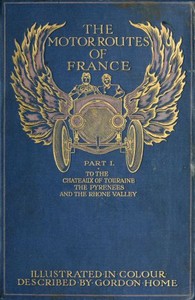
The Motor Routes of France To the Châteaux of Touraine, Biarritz, the Pyrenees, the Riviera, & the Rhone Valley — Themes and Context
(0 User reviews)
493
Project Gutenberg
2018
Not confirmed
France -- Description and travel; Automobile travel -- France -- Guidebooks
Readers of public-domain and historical texts
Project Gutenberg digital edition
en
Edition facts
Words
83,785
Reading time
365 min
Text sections
18
For The Motor Routes of France To the Châteaux of Touraine, Biarritz, the Pyrenees, the Riviera, & the Rhone Valley — Themes and Context, the stored edition analysis reports 83,785 words, 6 hr 5 min estimated reading time, and 18 detected text sections.
The text analysis averages about 19.9 words per sentence, while the detected sections provide another way to judge how the source is divided.
Project Gutenberg metadata also associates the work with “France -- Description and travel,” connecting these edition facts with the source record’s subject description.
Source:
Project Gutenberg record #57133
Gordon Home's 1910 guidebook structures motor tours through France by route, blending practical road advice with historical and architectural notes. The work moves from northern plains to Pyrenees and Riviera, using recurring contrasts between medieval keeps and Renaissance châteaux, and between swift travel and detailed local lore.
Read the complete public-domain text at its original source.
Read on Project GutenbergGordon Home's The Motor Routes of France (1910) organizes its tour not by region alone but by the logic of the road: each chapter follows a single route, from the wheat plains of the North to the mountains and sea of the South. The book's structure mirrors the motorist's experience—moving swiftly between towns, yet pausing for historical and architectural commentary. Home repeatedly contrasts the medieval keeps of Gaston Phœbus with the Renaissance façades of later rulers, and he notes how the car's speed alters one's perception of landscape. The preface emphasizes the book's pocket-sized format and large type, designed for reading while the car is in motion.
Route as Organizing Principle
Home divides the tour into distinct routes, each with its own chapter: to the Châteaux of Touraine, to Biarritz and the Pyrenees, to the Riviera, and along the Rhone Valley. Within each route, the narrative follows the road's sequence, noting distances, road conditions, and notable sights. For example, the approach to Pau includes a detailed account of the Château's history, from the fourteenth-century red-brick keep built by Gaston Phœbus to the Renaissance façade restored by Henri d'Albret. This structure allows Home to blend practical travel advice—such as opening hours and hotel charges—with historical digressions, all while maintaining the forward momentum of the journey.
Recurring Images: Keeps and Façades
Throughout the excerpts, a visual pattern emerges: medieval keeps of red brick or stone are contrasted with later Renaissance additions. At Pau, the 'fourteenth-century keep of red brick' stands to the left of the courtyard, while the 'beautiful façade' restored by Henri d'Albret overlooks the river. This juxtaposition recurs in descriptions of other châteaux, where Home notes the original defensive structures and the later ornamental wings. The images reinforce a sense of layered history, where each building bears the marks of successive rulers. Home also uses the motif of the 'grand salon' as a site of historical drama, as in the tapestry-hung room at Pau where a massacre occurred.
Movement Between Scenes: From Road to Room
Home's narrative moves fluidly from the open road to the interior of a château, then back to the road. A typical passage begins with the approach to a town, describes its setting, then enters a building for a historical anecdote, and finally returns to practical notes. For instance, the account of Pau shifts from the castle's exterior to the 'Chambre de Henri IV' and the tortoiseshell cradle, then to a quoted story about the king's birth, and ends with opening hours. This rhythm mimics the motorist's own stops and starts, creating a sense of continuous travel punctuated by moments of focused attention.
The Car as a Lens for Landscape
Home frequently remarks on how the automobile changes the traveler's experience of France. In the preface, he notes that the 'wide national ways' allow a rapid car to pass without 'destroying the peace or beauty of the neighbourhood.' The book's large type is chosen for easy reading 'while the car is in motion,' implying that the motorist is both a spectator and a participant in the landscape. The routes are chosen for their diversity—from wheat plains to mountains and sea—and the car's speed enables a tour that would be impractical by other means. Yet Home also lingers on details that require stopping: the architecture, the history, the local legends. The car thus becomes a tool for both swift coverage and focused exploration.
Readers approaching this guidebook should expect a hybrid work: part practical itinerary, part historical commentary, part travelogue. The structure rewards those who follow the routes in order, but the index and maps allow for targeted reading. Home's voice is that of an informed companion, not a dry encyclopedist; he assumes the motorist has both curiosity and a sense of adventure. The book is best used as a pre-tour planning tool or as a companion during the journey itself, its large type and pocket size designed for the road.
There’s something about Gordon Home’s old routes—the way he lingers over a ruined keep while the engine idles—that feels like time folding in on itself. I found that same quiet ache in The lieutenant and commander — Story, Setting & Ideas, where movement and memory blur. Both leave you slightly wistful for places you’ve never actually been.
There are no reviews for this eBook.
There are no comments for this eBook.
Reader reflection
How will you remember this book?
Save your reaction, strongest insight, and memorable passage.
Your progress
0
/
10
2
What was your overall reaction to the book?
3
Is this a title you would suggest to others?
4
What was the reading difficulty like?
5
Would this book work well in a reading group?
6
How strongly did the book affect you emotionally?
7
How did the pace of the book feel?
8
What did you appreciate most?
9
What changed or sharpened your thinking?
10