1

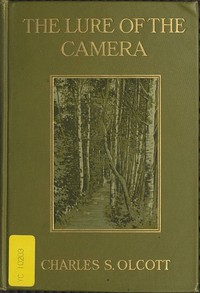
The Lure of the Camera — A Closer Reading
(0 User reviews)
358
Project Gutenberg
2011
Not confirmed
Photography; Voyages and travels
Readers of public-domain and historical texts
Project Gutenberg digital edition
en
Edition facts
Words
69,936
Reading time
305 min
Text sections
8
Before opening The Lure of the Camera — A Closer Reading, the edition data offers a quick orientation: 69,936 words, 5 hr 5 min estimated reading time, and 8 detected text sections.
The text analysis averages about 23.2 words per sentence, while the detected sections provide another way to judge how the source is divided.
Project Gutenberg metadata also associates the work with “Photography,” connecting these edition facts with the source record’s subject description.
Source:
Project Gutenberg record #35960
Olcott's rambling travelogue pairs his camera with literary and historic sites across Europe and America, blending scenic description with authorial anecdotes from Scott to Manzoni.
Read the complete public-domain text at its original source.
Read on Project GutenbergIn his preface, Charles S. Olcott distinguishes between a "ramble" and a "journey," framing the book as a series of incidental excursions made possible by more serious travels. He warns that readers must accept long flights—from Scotland to Italy, then back to New England and onward to Wyoming and Arizona—without regard for distance or direction, as ramblers take no account of time. The author's practice of carrying a camera for over a dozen years shapes the narrative: he seeks literary, historic, or scenic spots within easy reach, wandering from well-worn paths to study subjects at leisure. This opening establishes a deliberate, unhurried pace that contrasts with tourist itineraries.
The Camera as a Travel Companion
Olcott repeatedly emphasizes how the camera dictates his itinerary. In the preface, he notes that amateur photographers need leisure to find and study subjects, and they are likely to wander away from customary paths. This is not a guidebook; the rambles cannot be organized into an itinerary. The camera becomes a tool for discovery, leading him to places like the Borromean Islands on Lake Maggiore, where he contrasts the artificial terraces of Isola Bella with the squalor of the Isola dei Pescatori. His observations are precise: the ten terraces of Isola Bella are built as a pyramid, covered with transported earth, allowing orange and lemon trees to wave "in the face of Alpine snows." Such details ground the narrative in specific, visual moments.
Literary and Historical Anchors
Olcott's rambles are often anchored to authors or historical figures. He mentions Manzoni, whose novel I Promessi Sposi Scott called the finest ever written, and who lived in Belgirate. He describes St. Charles Borromeo of Arona, noting his colossal statue (66 feet high on a 40-foot pedestal) and his heroic work during the Milan plague of 1575, but also his persecution of heretics. The author includes a striking anecdote: a Franciscan monk fired at Borromeo, but the bullet glanced off the gold embroidery of his cope—"a demonstration that gold lace is not always a wholly superfluous decoration." These asides blend biography with wry commentary, enriching the travel narrative without overwhelming it.
Contrasts in Landscape and Society
Throughout the excerpts, Olcott draws contrasts between natural beauty and human intervention. On Lake Maggiore, he notes that the hand of Nature provides rich beauty, while man's creations—villas, gardens, vineyards—accentuate the charm. Yet he also juxtaposes the opulent Isola Bella with the poor fishermen's island, which from a steamer's deck is "far more picturesque than its more pretentious neighbor." The third island, Isola Madre, with its seven terraces and profuse gardens, is less popular but considered by many more attractive. These comparisons reveal a nuanced eye: Olcott values both the artificial and the natural, but he does not shy from acknowledging the social realities behind the scenery.
A Rambler's Rhythm: Steamer Stops and Side Trips
The narrative moves by a series of small journeys: a steamer zigzags back and forth, stopping at many villages until reaching Luino, birthplace of Bernardino Luini. From there, a short tramway ride leads to Ponte Tresa on Lake Lugano, where another boat waits. Olcott notes that most of Lake Lugano is in Swiss territory, though it is usually regarded as an Italian lake. This rhythm—steamer, tramway, boat—mirrors the rambler's casual approach. He does not rush; he lingers at each stop, observing details like the frescoes of Luini or the site of Garibaldi's exploit. The reader is invited to follow without a timetable, accepting the meandering pace as part of the experience.
Olcott's book rewards readers who share his inclination to wander without a fixed plan. The camera serves not merely as a recording device but as a reason to pause and look closely. As you read, note how the author's voice shifts between descriptive travelogue, historical sketch, and personal anecdote—a blend that mirrors the rambler's freedom. The excerpts suggest that the full work will offer similar juxtapositions across continents, always returning to the idea that pleasure, not business, guides the journey.
Olcott's restless shutter loved the echoes in stone, yet the quieter comfort lives in that old volume where travel maps and tales sit side by side. Both smell of dust and patience. I’ve often left one open upon the other, a gentle dialogue between wanderers. The World's Greatest Books — Volume 19 — Travel and Adventure — Context and Discussion holds that same palm-worn warmth, a familiar hush along the shelf.
There are no reviews for this eBook.
There are no comments for this eBook.
Reader reflection
Record your reading impressions
A brief reflection can help important ideas stay with you longer.
Your progress
0
/
10
2
How did the book work for you overall?
3
Would you pass this book on to a friend?
4
What was the reading difficulty like?
5
How did the pace of the book feel?
6
Did you gain anything practical from the text?
7
How personally connected did you feel to the book?
8
What did you appreciate most?
9
What is the main idea you are taking away?
10