1

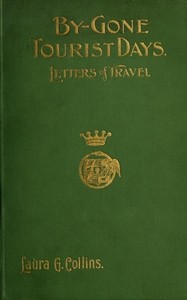
By-gone Tourist Days: Letters of Travel — Key Ideas to Explore
(0 User reviews)
351
Project Gutenberg
2015
Not confirmed
Voyages and travels; Europe -- Description and travel
Readers of public-domain and historical texts
Project Gutenberg digital edition
en
Edition facts
Words
72,052
Reading time
314 min
Text sections
9
For By-gone Tourist Days: Letters of Travel — Key Ideas to Explore, the stored edition analysis reports 72,052 words, 5 hr 14 min estimated reading time, and 9 detected text sections.
The text analysis averages about 17.5 words per sentence, while the detected sections provide another way to judge how the source is divided.
Project Gutenberg metadata also associates the work with “Voyages and travels,” connecting these edition facts with the source record’s subject description.
Source:
Project Gutenberg record #48728
A collection of letters from an American woman traveling through Europe in the 1880s, focusing on her observations of place, customs, and the passage of time, with a distinctive voice that blends personal reflection with detailed description.
Read the complete public-domain text at its original source.
Read on Project GutenbergThe letters in this collection, written by Laura G. Collins during her travels through Europe in the 1880s, are structured as personal correspondence to friends, a form that shapes both their content and tone. Rather than a continuous narrative, the book presents discrete episodes, each anchored to a specific date and location, from London to Heidelberg to Nuremberg. This epistolary structure allows Collins to shift between detailed descriptions of cathedrals and landscapes, and intimate reflections on aging, sleep, and the pleasures of reading. The letters are not merely travelogue; they are meditations on the experience of being a tourist in an era when transatlantic travel was still a notable undertaking.
The Epistolary Frame and Its Effects
The book’s format as a series of letters is not incidental. Each letter is addressed to a specific recipient, and Collins frequently references the act of writing itself, as when she notes, “I am not writing a book, painting a picture, composing an opera.” This self-awareness underscores the informal, conversational quality of the prose. The letters are dated and often include details about the circumstances of their composition, such as the time of day or the writer’s mood. This structure creates a sense of immediacy and intimacy, as if the reader is eavesdropping on a private exchange. It also allows Collins to move freely between topics, from the architecture of Oxford to the customs of a French New Year’s celebration, without the need for a unifying plot.
Recurring Images of Time and Transience
Throughout the excerpts, Collins returns to the theme of time’s passage. She writes of begrudging hours given to sleep, feeling “as if just risen from refreshing slumber” yet reluctant to rest. The phrase “the years they are going” appears in a poem she quotes, and she laments that “the days come and go as swiftly as so many rays of light.” This preoccupation with transience is woven into her descriptions of places, as when she notes the “enchantment and charms of the old city” of Nuremberg, or the “historic points” along the Neckar. The letters are punctuated by moments of reflection on aging and the fleeting nature of experience, giving the travel narrative an elegiac undertone.
Movement Between Scenes and Settings
Collins’s letters are marked by rapid shifts in setting, often within a single paragraph. In the Heidelberg letter of August 16, 1882, she moves from “the Neckar” to “the places I have been” to “sketches over the line of travel.” This technique mirrors the experience of a tourist moving quickly from one sight to another. The table of contents lists a cascade of locations: London, Chester, Liverpool, Chatsworth, Stratford, Oxford, Warwick. Yet Collins also lingers on specific details, such as the “lime tree” or the “lamp that has been lighted since 1326” in Nuremberg. The juxtaposition of rapid movement and focused observation creates a rhythm that is both restless and attentive.
The Voice of the Traveler
Collins’s narrative voice is distinctive for its blend of earnestness and self-deprecation. She describes herself as “not writing a book, painting a picture, composing an opera,” yet her letters are carefully crafted. She is an avid reader, referencing “Characteristics” and “Library Notes,” and she shares her enthusiasm for books with her correspondents. Her tone can be playful, as when she recounts a New Year’s party where guests “fished” for presents, or rueful, as when she admits to shunning sleep. This personal voice gives the letters a sense of authenticity, even as Collins is clearly aware of her audience. The reader is invited to share in her discoveries and her doubts, making the travel narrative as much about the traveler as about the places visited.
Readers approaching this collection should attend to the interplay between the public and private dimensions of the letters. Collins is both a tourist describing famous sights and a woman reflecting on her own life. The letters reward careful reading for their specific observations—the “china pig” in a Twelfth Night cake, the “five sisters” window at York—and for the way they capture a moment in the history of travel. The book is best enjoyed as a series of discrete glimpses, rather than a continuous narrative, and its charm lies in the voice of its author, who is by turns curious, witty, and wistful.
That letter collection stayed with me for how lightly it carries heavy things—time passing, places changing under your feet. It reminded me of quieter moments in Travels in Syria and the Holy Land — Themes and Context, where the same sense of fleetingness lingers. Both feel like someone holding a memory up to the light, gently, before letting it go.
There are no reviews for this eBook.
There are no comments for this eBook.
Reader reflection
Your personal reading reflection
Build a private reading journal entry for this title.
Your progress
0
/
10
2
How did the book work for you overall?
3
Would you recommend this book to another reader?
4
How much effort did this book require?
5
Would this book work well in a reading group?
6
How clear did the writing feel?
7
Is this a title worth rereading?
8
Which element worked best for you?
9
In one sentence, what did you learn?
10