1

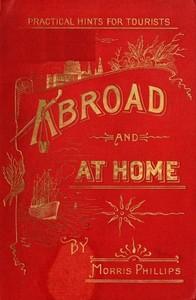
Abroad and at Home; Practical Hints for Tourists — Reading Notes
(0 User reviews)
2866
Project Gutenberg
2017
Not confirmed
Travel; Travel -- Guidebooks
Readers of public-domain and historical texts
Project Gutenberg digital edition
en
Edition facts
Words
79,708
Reading time
347 min
Text sections
10
For Abroad and at Home; Practical Hints for Tourists — Reading Notes, the stored edition analysis reports 79,708 words, 5 hr 47 min estimated reading time, and 10 detected text sections.
The text analysis averages about 21.6 words per sentence, while the detected sections provide another way to judge how the source is divided.
Project Gutenberg metadata also associates the work with “Travel,” connecting these edition facts with the source record’s subject description.
Source:
Project Gutenberg record #53924
Morris Phillips offers practical advice for late-19th-century travelers, combining steamship and railway logistics with candid restaurant critiques and cultural observations from Europe and America.
Read the complete public-domain text at its original source.
Read on Project GutenbergMorris Phillips opens Abroad and at Home; Practical Hints for Tourists with a barrage of steamship and railway advertisements, immediately grounding the reader in the commercial infrastructure of late-19th-century travel. The Inman Line, the London & North Western Railway, and Simpson’s Divan Tavern are not mere decorations; they signal that this guidebook is embedded in the actual business of getting from place to place. Phillips then shifts into a voice that is at once authoritative and wry, warning tourists away from prix fixe dinners while praising the Bouillon Duval chain for its honesty. His prose moves between practical logistics and sharp cultural commentary, often within the same paragraph.
The Rhetoric of the Timetable
The opening pages of the book are dominated by advertisements that read like a primer on transatlantic travel in the 1880s. The Inman Line’s “CITY OF PARIS, 10,500 Tons” and the London & North Western Railway’s promise of “FOUR AND A-HALF HOURS to GLASGOW” are not just promotional material; they establish a tone of efficiency and scale. Phillips lets these announcements speak for themselves, but his own writing later echoes their precision. He notes that a round-trip ticket can be “used by RED STAR LINE from Antwerp,” revealing a network of alliances. The effect is to make the reader aware that every journey is a chain of decisions—which steamer, which railway, which hotel—each with its own cost and comfort level.
Dining as Cultural Barometer
Phillips devotes considerable attention to food, using restaurant reviews to measure national character. He declares that “the raw material of the Parisian restaurant cuisine is inferior to that of English restaurants,” but concedes that “the preparation of the dishes is superior.” He admires French vegetables and sauces while dismissing the roasts as insipid. His advice to “avoid prix fixe dinners altogether” is delivered with a dry warning about restaurateurs “in league with the honorable apothecaries.” The Bouillon Duval, by contrast, earns his approval for serving “good and genuine” food, though he notes that small portions can make the bill mount up. These passages reveal a writer who trusts his palate and expects his reader to value discernment over thrift.
The Voice of the Cautious Critic
Phillips is acutely aware of the risks of public judgment. He writes that “the critic has the right to declare a book or picture bad,” but “he dare not be so outspoken about the wretchedest restaurant-keeper.” This self-imposed restraint shapes his tone: he praises by naming establishments (Duval, Dîner Européen) but damns by implication, leaving the reader to infer which restaurants are “expensive delusions.” His caution extends to pricing—he calculates that “a healthy and honest plate of meat” cannot cost less than one and a half francs—and to the logistics of the Duval system, where a “bulletin” serves as both order slip and passport. The effect is a guide that feels both personal and guarded, as if Phillips is sharing secrets among friends.
Specimens of Humanity at the Table d’Hôte
Phillips’s descriptions of the grand hotel dining rooms are among his most vivid. At the Hôtel du Louvre or the Grand Hôtel, he writes, you see “specimens of men, women and children of all the countries of the world,” surrounded by “a profusion of linen, of silver plate, and luxurious surroundings.” The word “specimens” is telling: Phillips treats the cosmopolitan crowd as part of the spectacle, a living exhibit of global tourism. Yet he undercuts the grandeur by noting that the roasts are insipid and the sauces cheap. This tension between surface luxury and underlying mediocrity runs through the book, reminding the reader that travel is as much about managing disappointment as about discovery.
Phillips’s guide is best read as a period artifact that rewards attention to its authorial voice. His blend of practical advice, culinary criticism, and wry observation offers a window into the expectations and anxieties of the late-Victorian tourist. Readers interested in the history of travel writing or the sociology of tourism will find rich material here, particularly in the way Phillips navigates between commercial promotion and personal judgment.
I’ve been thinking about that old guidebook, the one with steamship schedules and restaurant complaints—how strange it feels to read someone’s travel fussiness now, like a voice from a locked room. It made me remember Life and Travel in India Being Recollections of a Journey Before the Days of Railroads — Themes and Context, where the journey itself is slower, more uncertain. Both left me with a quiet ache for a world I’ll never board.
There are no reviews for this eBook.
There are no comments for this eBook.
Reader reflection
What did you think of this book?
Answer a few questions and save a private reflection on this device.
Your progress
0
/
10
2
How did the book work for you overall?
3
How likely are you to recommend this book?
4
How demanding did the text feel?
5
How clear did the writing feel?
6
Could you see yourself revisiting this book?
7
Did the book deliver what you hoped for?
8
How valuable was this book for your own interests?
9
In one sentence, what did you learn?
10