About 178 minutes
Roving East and Roving West — Reading Companion
Geography
40,782 recorded words. 11 minutes difference from this book's estimate.
View Gutenberg source #7237
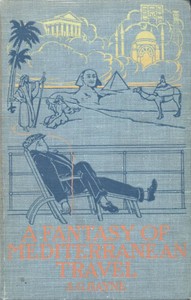
Before opening A Fantasy of Mediterranean Travel — Reading Notes, the edition data offers a quick orientation: 38,270 words, 2 hr 47 min estimated reading time, and 5 detected text sections.
The text analysis averages about 26.1 words per sentence, while the detected sections provide another way to judge how the source is divided.
Project Gutenberg metadata also associates the work with “Mediterranean Sea -- Description and travel,” connecting these edition facts with the source record’s subject description.
Explore this collection
These alternatives are selected using recorded categories and estimated reading time.
About 178 minutes
Geography
40,782 recorded words. 11 minutes difference from this book's estimate.
View Gutenberg source #7237About 184 minutes
Geography
42,238 recorded words. 17 minutes difference from this book's estimate.
View Gutenberg source #11297About 144 minutes
Geography
33,029 recorded words. 23 minutes difference from this book's estimate.
View Gutenberg source #57404Search stored excerpts and compare books → Choose by your preferences →
Choices use stored catalog measurements. Estimates vary with reading speed. A shared category is a catalog label, not a claim that two books have the same argument or literary quality.
Search reads excerpt text stored with this catalog and links to its associated Gutenberg record. The connection is stored in the site database; this tool does not recheck that every excerpt is word-for-word identical to that external record. Excerpt search does not cover every chapter and does not verify historical publication dates.
Catalog snapshot checked: 2026-09-25. Coverage: 91 public books, 91 available source excerpts.
Read the complete public-domain text at its original source.
Read on Project GutenbergSamuel G. Bayne opens A Fantasy of Mediterranean Travel not with a reverent description of the sea, but with a list of places visited—Madeira, Spain, Algiers, Constantinople, Jerusalem, Egypt—and a frontispiece portrait of the author. The tone is set early: this is a personal, anecdotal account, not a guidebook. Bayne, who had previously written Quicksteps through Scandinavia and On an Irish Jaunting-Car, brings a practiced eye for the absurd. In the excerpts, he describes a reception in Jerusalem where guests are given ancient lamps labeled “wise” and “foolish virgins”; when he asks for a “foolish virgin,” the hostess’s face turns to stone. The episode ends with him “hiking” back to the hotel, a self-deprecating social failure. This blend of antiquities and embarrassment is characteristic.
Bayne’s prose moves easily from biblical references to contemporary jokes. In the scarab passage, he notes that genuine scarabs “have lain beside a Pharaoh in his grave long before Noah thought of laying the keel of his Mauretania”—a steamship anachronism that collapses millennia into a punchline. He compares archaeological excavation to Nevada mining: “sometimes they ‘strike it rich.’” This irreverence extends to the Bedouin at the “Good Samaritan” Inn, who claims to have killed Napoleon at Waterloo. Bayne calls it “the grandest and most daring lie I had ever heard” and rewards it with a quarter. The humor is dry, self-aware, and consistently undercuts any potential solemnity.
The book follows a cruise itinerary, but the excerpts suggest Bayne arranges material by theme or comic set-piece rather than strict chronology. The reception scene in Jerusalem, for instance, is less about the city’s history than about social awkwardness. The Dead Sea chapter includes a photograph caption: “THE DEAD SEA WITH THE LONE FISHERMAN IN FRONT. HE HAS JUST HEARD THAT THE FISH ARE NOT BITING AND IS SOMEWHAT DEPRESSED IN CONSEQUENCE.” This caption, like the text, treats a biblical site as a stage for a one-liner. Bayne also includes contemporary political events: the hanging of “three leaders of the Armenian massacre on the Galata Bridge” in 1909 appears in the illustrations, grounding the fantasy in recent news.
Throughout the excerpts, Bayne positions himself as a slightly bumbling outsider. He asks for the wrong lamp, he pays for a tall tale, he describes the “protection” payments to Bedouin chiefs as “Gilbert and Sullivan” comedy. He is not a heroic explorer but a man who “put his foot in it.” This self-deprecation is a deliberate rhetorical stance, contrasting with the grand settings. The illustrations also reinforce this: one shows “THE MOOSKI” in Cairo, described as a market where “every minute is a bargain day.” Bayne’s eye is drawn to the transactional, the absurd, and the human-scale detail rather than the monumental.
The excerpts cover only the Jerusalem and Jericho sections, plus the opening matter. The full book includes stops in Madeira, Spain, Algiers, Malta, Greece, Turkey, Asia Minor, Egypt, Messina, Naples, Pompeii, Rome, Villefranche, Nice, Monte Carlo, and England. It is impossible to know from these excerpts how Bayne handles the earlier or later ports. The tone may shift, or the “fantasy” of the title may become more pronounced. Readers should expect a consistently personal, anecdotal style, but the balance of humor, history, and description across the entire itinerary remains to be discovered.
Bayne’s A Fantasy of Mediterranean Travel rewards readers who enjoy travel writing that prioritizes personality over piety. The excerpts suggest a book best read in short bursts, savoring the comic set-pieces and the author’s distinctive voice. Pay attention to the captions and asides; they often carry the punchline. And if you find yourself at a reception where ancient lamps are distributed, think twice before requesting a “foolish virgin.”
There’s something touching about how Bayne treated a dusty roadside shrine with the same quiet curiosity as a crowded bazaar—everything worthy of notice, nothing needing reverence. It reminded me of an older companion volume, The World and Its People, Book VII: Views in Africa — Reading Companion, whose plainspoken wanderings felt similarly unhurried, like a lantern passing slowly over unfamiliar walls.
A brief reflection can help important ideas stay with you longer.