1

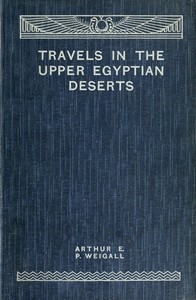
Travels in the Upper Egyptian deserts — Text and Context
15
2
Project Gutenberg
2023
Egypt -- Antiquities; Egypt -- Description and travel
Readers of public-domain and historical texts
Project Gutenberg digital edition
en
Edition facts
Words: 49,008
Reading time: 214 min
Text sections: 7
Source:
Project Gutenberg record #70394
Weigall's account of desert inspections blends archaeological observation with vivid descriptions of landscape, light, and movement, using a structure that shifts between technical detail and dreamlike narrative passages.
Arthur Weigall's Travels in the Upper Egyptian Deserts opens not with a map or a preface but with a description of a goatherd's flock appearing over a hill at twilight, a moment he calls 'a part of the dream.' The book's structure alternates between practical travelogue—routes, wells, quarry sites—and passages of sustained, almost hypnotic observation. Weigall, Inspector-General of Upper Egypt, wrote these chapters in leisure hours from official reports, and the text retains a dual character: precise about inscriptions and ancient roads, yet willing to let the desert's 'indistinct region of unrealities' take over the prose.
Movement and Stillness in the Desert Landscape
Weigall repeatedly frames desert travel as a play between motion and suspension. The camels 'swing up the valley at a brisk trot,' yet the narrative often pauses on a hilltop to watch a flock pass 'so silently' that it seems part of a dream. The goatherd's pipe and the 'gentle patter' of hooves are described as sounds that 'augment the dreamy character' rather than break it. This tension—between purposeful inspection and contemplative stillness—shapes the book's rhythm. Weigall notes that in the twilight he had 'little desire to read' because his mind was 'wandering' in 'an indistinct region of unrealities.' The desert itself seems to resist forward momentum, pulling the observer into a state where time and distance blur.
The Texture of Light and Colour
Colour is a persistent structural element. Weigall records the sky turning 'golden red' to 'green' to 'deep blue,' and mountains appearing 'purple' against the horizon. He notes 'celestial harmonies of tone' in the misty air, and the way 'reflected light' tinges the eastern sky with 'a suggestion of purple.' These observations are not decorative; they anchor the reader in specific times of day and weather conditions. The 'misty air' softens mountain groups, blending their colours, while the 'cloudy sun' sends beams up from behind dark hills. Weigall's eye for gradation—from the 'dim' light of evening to the 'bracing and keen' air of a sunless afternoon—gives the landscape a tactile, shifting presence.
Quarries, Inscriptions, and the Work of Inspection
Beneath the lyrical surface, the book is a record of archaeological inspection. Weigall visits the quarries of Wady Hammamât, the imperial porphyry quarries, and Mons Claudianus, noting cartouches of Sety II and Greek inscriptions at Wady Abâd. He thanks colleagues for notes on these texts. The structure follows the logic of official travel: routes are named, distances implied, and practical details—camels after a long drink, the need for clear tracks—are woven into the narrative. Yet Weigall rarely lingers on technical description; instead, he lets the ancient workings emerge within the same landscape that produces the dreamlike flocks and changing light. The result is a text where archaeological data and sensory impression coexist without one dominating.
Sound and Silence as Narrative Devices
Weigall uses sound to mark transitions between solitude and encounter. In the stillness of evening, 'not a sound' is heard 'except once when an unseen flight of migratory birds passed with a soft whir.' The goatherd's pipe introduces a 'plaintive bleating' and a 'wandering refrain' that fades as the flock rounds a bend. Later, the camels' brisk trot and the 'shuffle and patter' of hooves on gravel become the dominant auditory texture. Silence itself is described as 'warm, perfect stillness' that 'anticipates the dead sleep of night.' These acoustic details give the prose a measured, almost musical pacing, and they reinforce the book's central structural contrast: the desert is both empty and filled with small, precise events.
The Dream as a Framing Device
Weigall repeatedly uses the language of dreams to describe his desert experiences. The flock appears 'as a part of the dream,' and he wonders if the fading of the scene is due to 'the fading of the dream.' He writes that the mind 'was wandering, as the eyes were, in an indistinct region of unrealities.' This framing is not merely atmospheric; it shapes how the reader understands the book's shifts between observation and reflection. The dream metaphor allows Weigall to treat the desert as a space where ordinary categories—time, distance, reality—become unstable. Yet he never abandons the factual basis of his travels. The dream is a lens, not a replacement for evidence.
Readers will find that Travels in the Upper Egyptian Deserts rewards attention to its transitions: the moment when a practical detail gives way to a long view, or when a precise colour note becomes the anchor for a paragraph of meditation. Weigall's prose is best approached not as a continuous argument but as a series of carefully composed scenes, each with its own light, sound, and pace. The book's value lies in how it holds together the inspector's eye and the dreamer's voice without letting either dominate.
Reader reflection
How will you remember this book?
Save your reaction, strongest insight, and memorable passage.
Your progress
0
/
10
2
What was your overall reaction to the book?
3
Would you encourage someone else to read it?
4
What was the reading difficulty like?
5
How much did the book move you?
6
Did the book give you something worth debating?
7
Could you follow the author’s main argument?
8
Do you expect to return to this book?
9
In one sentence, what did you learn?
10