1

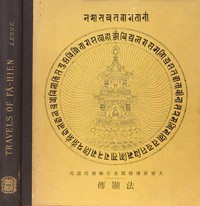
A Record of Buddhistic Kingdoms Being an account by the Chinese monk Fa-hsien of travels in India and Ceylon (A.D. 399-414) in search of the Buddhist books of discipline — A Reader’s Guide
10
1
Project Gutenberg
2006
Buddhist pilgrims and pilgrimages -- India -- Early works to 1800; Buddhism -- Early works to 1800; Asia -- Description and travel -- Early works to 1800
Readers of public-domain and historical texts
Project Gutenberg digital edition
en
Edition facts
Words: 53,592
Reading time: 234 min
Text sections: 43
Source:
Project Gutenberg record #2124
James Legge's annotated translation of Faxian's 5th-century pilgrimage record, with detailed notes on Buddhist terminology and textual variants from a Japanese edition.
Editorial Edition Score
4.9/5
★★★★★
★★★★★
Calculated from edition completeness, EPUB availability, text structure and catalogue metadata. Not a user rating.
Edition quality
James Legge's translation of Faxian's travel narrative is preceded by a substantial preface in which Legge recounts his own decades-long struggle to read the Chinese text, hindered by phonetic Sanskrit transcriptions and worn block-printed copies. The work is presented as a tripartite edition: translation, copious notes, and a Chinese text supplied from Japan by Mr. Bunyiu Nanjio. Legge states that portions were written out three times and the whole twice, indicating a meticulous process of revision.
The Translator's Approach to the Text
Legge's preface reveals his method: he lectured on the travels with a Davis Chinese scholar who was also a Boden Sanskrit scholar, then wrote two independent translations before completing the whole. The notes show a comparative approach, citing sources such as Eitel's Handbook for the Student of Chinese Buddhism, the Sacred Books of the East, and Beal's Records of Western Countries. Legge frequently glosses Chinese terms with their Sanskrit equivalents, as when he explains that the Chinese synonyms for ho-shang derive from an Indian term for teachers of part of the Vedas, later adopted by Buddhists in Central Asia to distinguish priests from Lamas.
Annotations as a Window into Buddhist History
The notes extend beyond philology into narrative and doctrine. Legge identifies figures such as Devadatta as Buddha's enemy across successive births, citing Vinaya Texts for the account of his destruction. He clarifies that the term devalaya is used by Faxian only for Brahmanical temples, while Buddhist temples came to be called sze after the White-horse Court built for Kasyapa Matanga. One note compares beggars at a Hong Kong cathedral to those at Chinese tutelary temples and Mount T'ai, drawing a parallel between religious almsgiving in different traditions.
Textual Evidence from the Japanese Recension
Legge's translation is based on a text sent from Japan by Mr. Bunyiu Nanjio, described as a 'Corean recension' of the Chinese text. The preface explains that this copy provided a good, clear text, in contrast to the worn block-printed copies Legge had previously procured. The notes occasionally reference this textual basis, as when Legge remarks on the difficulty of construing a passage about Sundari, noting that the text 'cannot be so construed.' This attention to textual variation underscores the editorial care taken to present a reliable version of Faxian's record.
Catalog Subjects vs. Actual Content
The catalog lists this work under Geography, with subjects including Buddhist pilgrimages and early works on Asia. While the travel narrative itself fits these categories, the excerpts show that the bulk of the provided text consists of Legge's preface and extensive footnotes on Buddhist terminology, textual criticism, and comparative religion. The actual travel account is not visible in the excerpts; instead, the reader encounters a scholarly apparatus that addresses the difficulties of translating a 5th-century Chinese text. The catalog's secondary topic 'religion-theology' is more directly reflected in the annotations than in the travelogue itself.
Readers approaching this edition should be prepared for a work that is as much about the challenges of translation and textual scholarship as it is about Faxian's journey. Legge's annotations provide a dense layer of commentary that illuminates Buddhist history and Chinese philology, but the travel narrative itself must be sought within the chapters that follow the preface and introduction. The edition rewards those interested in the transmission of Buddhist texts and the history of Orientalist scholarship.
Reader reflection
Your personal reading reflection
Build a private reading journal entry for this title.
Your progress
0
/
10
2
What was your overall reaction to the book?
3
Would you encourage someone else to read it?
4
What was the reading difficulty like?
5
Did the book offer a fresh perspective?
6
Did any part of the book stay with you emotionally?
7
Would you start a conversation about this book?
8
Could you see yourself revisiting this book?
9
In one sentence, what did you learn?
10