1

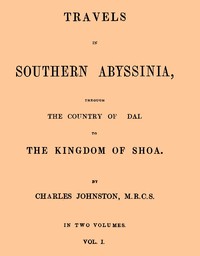
Travels in southern Abyssinia, Volume 1 (of 2) — A Reader’s Guide
21
3
Project Gutenberg
2023
Ethiopia -- Description and travel; Shewa Kifle Hager (Ethiopia) -- Description and travel
Readers of public-domain and historical texts
Project Gutenberg digital edition
en
Edition facts
Words: 126,903
Reading time: 552 min
Text sections: 34
Source:
Project Gutenberg record #72155
Charles Johnston's 1844 travelogue recounts his journey from the coast of Adal to the kingdom of Shoa, blending personal adventure with detailed observations of landscape, vegetation, and local customs. The opening preface establishes his motives and the support he received, while later excerpts show his methodical recording of natural history and daily travel challenges.
Editorial Edition Score
4.9/5
★★★★★
★★★★★
Calculated from edition completeness, EPUB availability, text structure and catalogue metadata. Not a user rating.
Edition quality
Charles Johnston opens his 1844 travelogue with a preface that frames the entire work as a personal gamble: he resigned a medical post in the East to travel across Africa, an ambition his friends questioned. The preface names specific patrons—Captain Washington of the Geographical Society, the Earl of Auckland, and Captain Haines in Aden—whose support enabled his journey. This network of official backing contrasts with the solitary, hazardous scenes that follow.
The first excerpt from the journey itself drops the reader into a specific moment: a halt near the Hawash River, where Johnston shoots guinea-fowl and collects a vegetable unfamiliar to him. The prose is precise about place names (Amardu, Koranhedudah) and natural details, signaling that the narrative will move between personal anecdote and scientific curiosity.
The Preface as a Contract with the Reader
Johnston’s preface is not a mere formality; it establishes the terms under which he asks to be judged. He writes that he “voluntarily assumed the character of an adventurer,” and that the value of his journey depends on the reader’s verdict. This framing invites scrutiny: the reader is to weigh the results against the sacrifice. The preface also reveals that Johnston prepared by purchasing instruments and an outfit, and that he sought introductions from the Geographical Society and the Indian government. These details hint at a methodical traveler, not a reckless wanderer. The dedication to his father, Thomas Johnston, adds a personal layer, suggesting the journey was also a filial offering.
Daily March and the Texture of the Landscape
The travel narrative proper is built around the rhythm of the march. In the excerpt describing the approach to Koranhedudah, Johnston notes that they had been “nearly four weeks almost daily marching” and had not reached halfway. This temporal marker gives the reader a sense of the journey’s scale. The landscape is described in physical terms: a long acclivity, a road “strewn with the everlasting lava cinders,” a circular spot surrounded by low black ridges. Pools of clear water and croaking frogs provide sensory detail. The presence of myrrh and mimosa trees, including one yielding gum arabic and another astringent gum, shows Johnston’s eye for botanical variety. He does not merely name plants; he compares them to familiar species, as when the myrrh tree reminds him of the common hawthorn.
Natural History as a Driving Motive
Johnston’s interest in natural history is not incidental but central. In the same excerpt, he recounts going in search of gum myrrh with Ebin Izaak, explicitly stating that he was “very anxious to procure specimens of the leaves, flowers, and seeds of the tree that yields this useful drug.” He notes that a description of the myrrh tree had long been “a desideratum in ‘Materia Medica.’” This remark connects his personal collecting to a broader scientific gap. He then provides a detailed botanical description, noting two varieties of myrrh tree, their leaf arrangements, flower structure, and classification under Linnaeus. The precision of this passage—down to the number of stamens and the shape of the calyx—reveals a trained observer. Johnston was a surgeon (M.R.C.S.), and his medical background informs his attention to useful plants.
Encounters with Companions and Local Knowledge
Johnston does not travel alone. The excerpts introduce figures like Ohmed Medina, who directs a Hy Soumaulee to gather a vegetable that the Banyans at Bombay are fond of. Ohmed Medina’s surprise at Johnston’s ignorance of the plant highlights the traveler’s dependence on local expertise. Similarly, Zaido appears as a camel-handler who stows the vegetable in a skin bag. These minor characters are named but not developed; they serve as functional presences in the daily routine. The text also records moments of shared activity: shooting guinea-fowl, lashing the dead antelope’s feet, waiting for camels. These details build a picture of a collective endeavor, even as Johnston remains the central consciousness. The reader is positioned alongside him, learning from his companions as he does.
Johnston’s narrative rewards a reader attentive to both the personal and the scientific. The preface sets expectations of risk and justification, while the journey itself delivers a steady accumulation of place names, botanical observations, and small dramas of travel. The excerpts suggest that the full volume will sustain this dual focus, moving between the immediate challenges of the road and the broader intellectual project of documenting an unfamiliar region. A first reading might profitably track how Johnston balances these two impulses, and how his companions and patrons recede or reappear as the journey progresses.
Reader reflection
Your personal reading reflection
Build a private reading journal entry for this title.
Your progress
0
/
10
2
How much did you enjoy the reading experience?
3
How likely are you to recommend this book?
4
How much effort did this book require?
5
How did the pace of the book feel?
6
Is this a title worth rereading?
7
Did you relate to its people, ideas, or situations?
8
How useful did the reading feel?
9
What did this book teach you most?
10