1

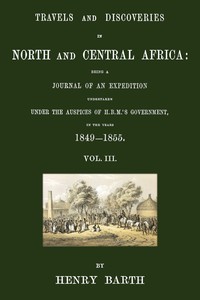
Travels and discoveries in North and Central Africa, Vol. 3 (of 5) — Reading Companion
21
2
Project Gutenberg
2025
Africa, Central -- Description and travel; Africa, North -- Description and travel
Readers of public-domain and historical texts
Project Gutenberg digital edition
en
Edition facts
Words: 171,887
Reading time: 748 min
Text sections: 23
Source:
Project Gutenberg record #76318
Heinrich Barth's third volume documents his 1849–1855 expedition through Bórnu and Kánem, blending topographical observation with political reportage. Excerpts reveal a meticulous diarist who records river names in multiple languages, notes the absence of fowl and milk, and describes the Shárí's banks at over forty feet high.
Editorial Edition Score
4.9/5
★★★★★
★★★★★
Calculated from edition completeness, EPUB availability, text structure and catalogue metadata. Not a user rating.
Edition quality
Heinrich Barth's journal of his 1849–1855 expedition, published in five volumes, reaches its third installment with the traveler deep in the Lake Tsád region. The excerpts show a narrator who is as attentive to the political maneuverings of local rulers as to the height of riverbanks and the taste of fish. Barth does not simply catalogue landscapes; he interrogates the names given to the Shárí by the Kótokó, Bagírmi, and Arabs, demonstrating a linguist's care for how geography is encoded in language. His account is punctuated by discomfort—mosquitoes, dense fog, a weak stomach—and by the constant negotiation of permission to move from one place to the next.
A River by Many Names
Barth devotes careful attention to the nomenclature of the Shárí River, noting that the name commonly used belongs to the Kótokó language, while the Bagírmi people call it simply Bá, distinguishing its course by adjacent villages: Bá-Mélé, Bá-Busó, Bá-Gún. The Arabs at that place call it Bahr-Mélé. He draws an analogy to the komádugu Wáúbe being called Yeou or Yó. This is not a passing remark; it reveals Barth's method of cross-referencing local knowledge against European maps. He also records that the river had overflowed its banks the previous year, entering the very huts of the natives, yet at his observation point the banks stood more than forty feet high. Such details ground the narrative in a specific hydrological moment.
Waiting and Discomfort
The excerpts convey a persistent theme of waiting—for supplies, for permission, for the sultan's return. Barth's impatience is tangible: he notes the approach of the rainy season, the overcast sky, the dense fog, and the mosquitoes that allow him little rest. His comforts are meager: no fowl or milk are procurable, and the fresh fish, though excellent, does not agree with his weak stomach. He mentions a small market at Édiye, five miles distant, and a Wednesday market near Chínge. These details sketch the material reality of travel in the region—a constant negotiation between expectation and scarcity. The narrative is as much about the gaps between destinations as about the destinations themselves.
Political Currents Beneath the Surface
Barth's journal is threaded with political intelligence. He reports that the sultan is waging war against the pagan inhabitants of Gógomí, who have descended from their mountain strongholds and slain a number of his people, including a well-known Arab from Morocco. Barth himself is subject to the sultan's authority: a document with a large black seal directs him to await the sultan's answer in Búgomán. The lieutenant-governor, the Zérma or Kadamánge, commands the capital in the sultan's absence. These passages show Barth as a participant in, not merely an observer of, the region's power structures. His movement is contingent on the approval of local authorities, and his record preserves the texture of that dependence.
Readers approaching this volume should expect a narrative that moves slowly, often stalled by protocol and weather, but rich in the kind of observation that only a patient traveler can provide. Barth's attention to linguistic variation, his frankness about physical discomfort, and his embeddedness in local politics make this a document of both geographical and historical value. The excerpts suggest a work best read not as a straight travelogue but as a layered record of encounter.
Reader reflection
Your personal reading reflection
Build a private reading journal entry for this title.
Your progress
0
/
10
2
What was your overall reaction to the book?
3
Would you encourage someone else to read it?
4
How easy was the book to follow?
5
Was the book what you thought it would be?
6
How personally connected did you feel to the book?
7
Was the book easy to understand?
8
Did anything about the book feel genuinely new?
9
What did this book teach you most?
10