1

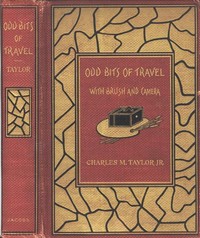
Odd Bits of Travel with Brush and Camera — A Closer Reading
5
1
Project Gutenberg
2011
Europe -- Description and travel; Netherlands -- Description and travel
Readers of public-domain and historical texts
Project Gutenberg digital edition
en
Edition facts
Words: 49,596
Reading time: 216 min
Text sections: 6
Source:
Project Gutenberg record #36110
Charles M. Taylor's 1900 travelogue pairs brush and camera to capture Dutch scenes, focusing on Marken and Monnikendam. The preface frames the book as a guide for artists seeking paintable subjects, while the Marken excerpt details a hotel's sparse rooms and the island's unchanging life.
Editorial Edition Score
4.7/5
★★★★★
★★★★★
Calculated from edition completeness, EPUB availability, text structure and catalogue metadata. Not a user rating.
Edition quality
Charles M. Taylor's Odd Bits of Travel with Brush and Camera (1900) opens with a preface that directly addresses two kinds of readers: the ardent worker who overcomes difficulties and the ease-loving follower of art. Taylor states his purpose is to guide both to places offering unusual attractions for the brush and camera, emphasizing that the selected spots are not linked by proximity but chosen for their paintable and photographic subjects. This practical, artist-oriented framing sets the tone for a book that blends travel narrative with practical advice.
The Preface as a Reader's Compass
Taylor's preface is more than a courtesy; it functions as a compact mission statement. He declares that the places described are selected from various lands and among widely differing peoples, with the sole purpose of locating scenes that teem with paintable and photographic subjects. He also promises to digress occasionally with bits of personal experience that may prove of interest or service to others. This dual promise—pictorial description plus practical anecdote—prepares the reader for a work that is neither a straight travelogue nor a technical manual, but a hybrid meant to inspire and inform.
The preface also reveals Taylor's awareness of his audience's constraints: he aims to tell of countries comparatively easy of access and where those of limited means may find satisfactory accommodations. This practical bent suggests that the book is intended for middle-class artists and photographers, not wealthy tourists. The reader should approach the text expecting concrete details about lodgings, costs, and local conditions alongside descriptions of scenery.
Marken: A Study in Stasis and Detail
The excerpt on Marken, an island in the Zuiderzee, exemplifies Taylor's method of combining observation with wry commentary. He describes the islanders as a peculiar race stranded upon a desert island, noting their stringent rules regarding marriage yet observing that there is no lack of weddings, given the overwhelming number of children. This tension between stated custom and visible reality is a recurring note in his writing.
Taylor's description of the hotel is particularly vivid: six rooms, a kitchen ten by ten, a dining-room twelve by fourteen that also serves as barroom, sitting-room, and smoking den. The furniture consists of a bare wooden table and six chairs, with snowy muslin curtains at the windows. Upstairs, three bedrooms are scantily furnished, and the rooms appear never to have been occupied by anyone more important than flies and mosquitoes. Taylor's sympathy for these insects—"ignorant creatures who do not seem to have strength enough to get away"—adds a touch of dark humor. The passage reveals Taylor's eye for the absurd and his willingness to undercut his own enthusiasm.
Costume and Custom as Visual Subjects
Taylor repeatedly emphasizes the visual appeal of local dress. On Marken, he notes that men and women in their odd costumes are rare pictures, and that the clothing is of a style worn hundreds of years ago, with no consciousness on the part of its wearers that there is anything unusual in its appearance. He quotes Thomas Gray's line, "Where ignorance is bliss, ’tis folly to be wise," suggesting that the islanders will continue to wear this antediluvian garb for centuries to come.
This focus on costume aligns with Taylor's stated purpose of finding characteristic figure studies for artists. He also observes practical details: much of the washing is done in the little canal, and linen is not worn to any great extent, so the coarse homespun garments are cleansed by a very simple process. These details ground the picturesque in everyday life, offering the reader both aesthetic appreciation and ethnographic information.
The Artist's Holland: Remote and Affordable
In the northern portion of Holland, away from larger cities like Amsterdam and Rotterdam, Taylor finds that letters of credit extend over an astonishing space of time, for a little money goes a long way among these people. He attributes this to the regions being too remote for the regular tourist, with no great influx of capital, and hence no inducement for the people to change their simple and primitive mode of living. Honesty, frugality, and contentment reign, and the visitor may enjoy the beautiful country and the pure, innocent life of its inhabitants.
This economic observation is crucial for the reader: Taylor is not describing a tourist destination but a place where an artist can live cheaply and work without distraction. The town of Monnikendam, some fifteen or sixteen miles north of Amsterdam, is presented as a rich and rare scene. The reader should note that Taylor's Holland is a land of quiet canals, grazing sheep, and fresh, balmy air—a place where the artist can find both health and subject matter.
Taylor's book rewards the reader who pays attention to his asides and practical details. The preface sets expectations for a work that is part travelogue, part artist's guide, and part personal memoir. The Marken excerpt shows his ability to blend sharp observation with dry humor, while the economic notes remind us that this is a book written for working artists, not armchair travelers. As you read, watch for the tension between Taylor's enthusiasm for the picturesque and his willingness to acknowledge the less romantic realities of his chosen subjects.
Reader reflection
How will you remember this book?
Save your reaction, strongest insight, and memorable passage.
Your progress
0
/
10
2
How much did you enjoy the reading experience?
3
Would you recommend this book to another reader?
4
What was the reading difficulty like?
5
How strongly did the book affect you emotionally?
6
Did anything about the book feel genuinely new?
7
Did the book meet your expectations?
8
Is this a title worth rereading?
9
What changed or sharpened your thinking?
10