1

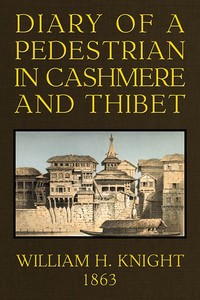
Diary of a Pedestrian in Cashmere and Thibet — Themes and Context
17
3
Project Gutenberg
2003
Jammu and Kashmir (India) -- Description and travel; Tibet Autonomous Region (China) -- Description and travel; Knight, W. H. (William Henry) -- Travel -- India -- Jammu and Kashmir; Knight, W. H. (William Henry) -- Travel -- China -- Tibet Autonomous Region
Readers of public-domain and historical texts
Project Gutenberg digital edition
en
Edition facts
Words: 85,711
Reading time: 373 min
Text sections: 10
Source:
Project Gutenberg record #3639
Captain Knight's 1863 travel diary records his pedestrian journey through Kashmir and Tibet, blending wry observations of local customs, encounters with a fierce sepoy named Dilour Khan, and a sardonic description of a Buddhist prayer roll containing 'Ûm mani panee' repeated thousands of times.
Editorial Edition Score
4.9/5
★★★★★
★★★★★
Calculated from edition completeness, EPUB availability, text structure and catalogue metadata. Not a user rating.
Edition quality
Captain W. H. Knight, a British officer of the Forty-eighth Regiment, presents his Diary of a Pedestrian in Cashmere and Thibet as an unpolished, firsthand account—'sketched and written during the leisure moments of a wandering life.' The narrative, originally private, was published in 1863 with minimal alteration, and Knight openly acknowledges his lack of prior acquaintance with other travel writers on the region. What emerges is a record marked by a dry, self-deprecating tone and a keen eye for the absurdities of cross-cultural encounter.
The Sepoy and the Pig-Tail
One of the most vivid figures in the diary is Dilour Khan, a sepoy whose name Knight translates as 'the Invincible One.' Knight portrays him as a 'fierce-looking soldier' who terrorizes local Tibetans to procure supplies. His method is described with comic precision: 'throwing aloft his sword, and relinquishing his umbrella, he used to seize suddenly upon a pig-tail, and, handling it after the fashion of a bell-rope, proceed to insist upon the production of impossible mutton.' The sepoy's theatricality—delivering a 'volley of Thibetian' while gesticulating and curling his moustaches—underscores the power dynamics at play. Knight himself admits to a 'weak moment' when he assaulted Dilour Khan, only to watch the sepoy redirect his violence onto villagers, forcing Knight to intervene. This episode reveals the tension between the author's authority and his dependence on a subordinate whose methods he both deplores and finds darkly amusing.
A Prayer Roll of Astonishing Length
Knight encounters a Buddhist prayer roll that he describes with a mixture of ethnographic curiosity and ironic disdain. The roll, 'sixty yards long,' is composed of strips of thin paper, each containing the phrase 'Ûm mani panee' repeated 170 times. He calculates that the entire roll holds between seventeen and eighteen thousand repetitions. The object is enclosed in a canvas cover 'open at both ends' and marked with what Knight speculates is 'the official seal of the particular society for the diffusion of ignorance at Lassa.' This wry characterization—calling the monastery a 'society for the diffusion of ignorance'—reflects his inability to penetrate the meaning of the mantra, which 'all appeared so ready to pronounce and none seemed able to explain.' The passage highlights the limits of Knight's understanding and his tendency to frame unfamiliar religious practices through a lens of British skepticism.
Negotiating a Necklace and the Fragility of Bargains
Near Pitok, Knight purchases a necklace of amber and turquoise from an old woman weaving goat's-hair cloth. The transaction is fraught: she takes two rupees for 'the family jewels' and then 'seemed in a desperate fright at what she had done, looking about in every direction to see that no avaricious old Lama was near.' The woman's fear of being caught by a Lama or a gossip reveals the social constraints operating beneath the surface of trade. Knight, as an outsider, becomes an unwitting catalyst for her anxiety. This brief scene encapsulates the precariousness of cross-cultural exchange in the region, where a simple sale could carry risks for the seller that the buyer barely perceives.
Knight's diary resists easy categorization: it is part travelogue, part military memoir, and part ethnographic sketch, all filtered through a personality that is by turns self-deprecating, observant, and unapologetically colonial. Readers should approach the text as a document of its time, noting where Knight's irony reveals more about his own assumptions than about the places he describes. The appended notes, drawn from scholars like Captain Cunningham, offer a counterpoint to the diary's spontaneous voice.
Reader reflection
How will you remember this book?
Save your reaction, strongest insight, and memorable passage.
Your progress
0
/
10
2
Was reading this book enjoyable?
3
Is this a title you would suggest to others?
4
How much effort did this book require?
5
Was the book what you thought it would be?
6
How distinctive were its ideas or approach?
7
Would this book work well in a reading group?
8
Would a second reading be valuable?
9
What changed or sharpened your thinking?
10