1

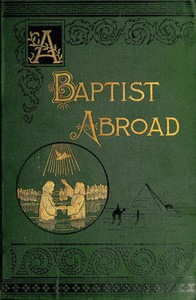
A Baptist Abroad: Travels and Adventures of Europe and all Bible Lands — Text and Context
7
1
Project Gutenberg
2016
Middle East -- Description and travel; Europe -- Description and travel
Readers of public-domain and historical texts
Project Gutenberg digital edition
en
Edition facts
Words: 125,387
Reading time: 546 min
Text sections: 55
Source:
Project Gutenberg record #50879
Whittle's 1890 travelogue blends Baptist perspective with detailed observations of Europe and Bible lands, focusing on Damascus, leprosy, and biblical sites, using vivid first-person narrative and historical asides.
Editorial Edition Score
4.9/5
★★★★★
★★★★★
Calculated from edition completeness, EPUB availability, text structure and catalogue metadata. Not a user rating.
Edition quality
Walter Andrew Whittle’s A Baptist Abroad (1890) opens with a dedication to his mother, who will read the book “through two pairs of spectacles”—one magnifying virtues, the other diminishing defects. The preface by Hon. J. L. M. Curry frames the work as a countryman’s view, emphasizing that Whittle’s religious denomination “naturally and properly, is not overlooked.” The catalog subjects list Europe and the Middle East, but the excerpts show a heavy tilt toward Damascus and biblical sites, with European chapters described as “short.” Whittle’s voice is conversational and self-aware, often addressing his companion Johnson or his servant Abraham directly.
A Preacher’s Gaze on Damascus
Whittle’s account of Damascus is anchored in biblical narrative. He visits the wall where Paul was let down in a basket, noting the wall is “some thirty feet high” and surmounted by a house occupied by a Christian family. He remarks that the reputed houses of Ananias and Judas are “certainly very old,” adding dryly: “if Ananias and Judas did not live in them at the time of Paul, some other people did.” This blend of piety and wry observation recurs throughout. Whittle explicitly links his own preaching to Paul’s fate: “If I should to-day begin to proclaim the gospel of Christ with the same zeal… I would have to be let down over the walls in a basket, or else be butchered on the street.” The passage reveals how Whittle uses biblical typology to frame his own experience, while also acknowledging the uncertainty of traditional identifications.
Leprosy, Naaman, and the Limits of Description
Chapter XXVIII, “The Naaman Hospital for the Leprosy,” is the most detailed excerpt. Whittle recounts Naaman’s story from 2 Kings, then visits the leper hospital in Damascus. He describes the scene with visceral language: “Living Corpses—Walking Skeletons.” The chapter heading lists “An Indescribable Scene—An Indelible Picture—Horrible Dreams.” Whittle’s method is to juxtapose scriptural narrative with contemporary observation. He quizzes Johnson on the origin of leprosy, citing Strabo’s claim that it “was generated in Egypt among the Jews.” The dialogue form—Whittle and Johnson exchanging questions—gives the travelogue a Socratic texture. Yet Whittle admits the limits of his description: the scene is “indescribable,” and the picture remains “indelible.” This tension between the urge to report and the inadequacy of language is a recurring structural feature.
Voice and Structure: The Traveler as Conversationalist
Whittle’s prose is marked by direct address and dramatic immediacy. He calls out “Abraham, Abraham” and receives a crisp “Sir?” He issues commands: “Bring out the horses, and let’s go to the hospital.” The narrative moves through dialogue, as when Johnson asks “Whittle, how long has the leprosy existed?” and Whittle replies with a mini-lecture. This technique creates a sense of shared discovery. The catalog subjects—Europe and Middle East—are unevenly treated; the excerpts suggest Palestine dominates. Whittle’s denominational lens is explicit: he visits Baptist-related sites and reflects on his own preaching. The book’s structure, with 55 text sections and a word count over 125,000, indicates a sprawling, episodic work. Readers should expect a personal, opinionated guide rather than a systematic survey.
Whittle’s travelogue rewards readers who enjoy nineteenth-century Protestant commentary on Bible lands. His voice is distinctive—part preacher, part tourist, part antiquarian. The excerpts show a writer unafraid to admit uncertainty (“with what degree of certainty, I can not say”) and to blend humor with horror. The book’s uneven coverage (short European chapters, long Palestinian ones) reflects the author’s priorities. Approach it as a period piece that reveals how a Baptist minister saw the world in 1890, rather than as a comprehensive guide.
Reader reflection
How will you remember this book?
Save your reaction, strongest insight, and memorable passage.
Your progress
0
/
10
2
Was reading this book enjoyable?
3
Would you pass this book on to a friend?
4
What was the reading difficulty like?
5
How strong was your personal connection to the text?
6
Did the book meet your expectations?
7
Did you gain anything practical from the text?
8
Did the book offer a fresh perspective?
9
In one sentence, what did you learn?
10