
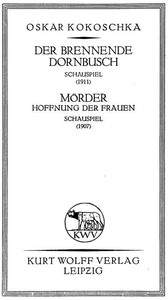
Der brennende Dornbusch; Mörder: Hoffnung der Frauen by Oskar Kokoschka
Before diving in, know this: Oskar Kokoschka was a painter first, a key figure in Expressionism. This play, his first, reads like a violent painting come to life. It throws out realistic plot and dialogue for pure, emotional spectacle.
The Story
The setup is simple but charged. A powerful Man, marked with tattoos and surrounded by his soldiers, encounters a commanding Woman and her maidens. There's no meet-cute. Instead, they immediately size each other up as adversaries. Their interaction is a series of symbolic acts of domination. The Man brands the Woman with his iron seal. She, in turn, has her maidens imprison and wound him. This back-and-forth of capture, branding, and defiance escalates until the Man's soldiers storm the Woman's tower. The climax is a frenzy of violence that leaves the Man seemingly dead and the Woman triumphant, but utterly hollow. The final image is of her alone, with the chilling realization that in destroying him, she has destroyed something essential in herself.
Why You Should Read It
Don't come here looking for likable characters or a comforting resolution. You read this for the raw, unfiltered emotion. Kokoschka isn't telling a love story; he's dissecting the terrifying, magnetic pull between two forces that can't live with or without each other. It's about possession, identity, and the war between the sexes stripped down to its mythological bones. The characters aren't people—they're archetypes, bursting with a energy that feels more real than any polite conversation. Reading it is a visceral experience. You feel the heat of the branding iron, the tension of the standoff, and the bleak emptiness of the end. It makes you think about all the unspoken power struggles in human relationships.
Final Verdict
This book is a punch to the gut, not a leisurely stroll. It's perfect for readers who love early 20th-century avant-garde art, theater that breaks all the rules, or anyone fascinated by the psychology of power and attraction. If you enjoy the intense emotional landscapes of artists like Edvard Munch or the fragmented fury of early German Expressionist film, you'll find a kindred spirit in Kokoschka. It's also shockingly short—you can read it in one sitting, but you'll be chewing on it for days. Just be ready for some chaos and don't expect any answers.
This work has been identified as being free of known copyright restrictions. Enjoy reading and sharing without restrictions.
Elijah Lee
7 months agoA bit long but worth it.
Karen Walker
1 year agoAs someone who reads a lot, it creates a vivid world that you simply do not want to leave. One of the best books I've read this year.
Jessica Ramirez
11 months agoI have to admit, the narrative structure is incredibly compelling. I learned so much from this.
Deborah Perez
1 year agoText is crisp, making it easy to focus.