
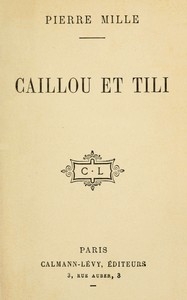
Caillou et Tili by Pierre Mille
Let's set the scene. It's France in the early 1900s. The world is changing fast, but in a small, rural village, life moves to the rhythm of the church bell and the harvest. Into this settled world comes Monsieur Caillou, the new schoolmaster. He's young, idealistic, and believes in science, progress, and secular values. His arrival is like a stone dropped in a still pond.
The Story
The ripples from that stone immediately reach the village priest, Abbé Tili. Tili is a good man, deeply loved, who has spent his life tending to his flock. He sees faith, tradition, and community as the bedrock of life. To him, Caillou's newfangled ideas are a direct threat to everything that holds the village together. What follows is a masterclass in low-key conflict. There are no villains here. Caillou isn't trying to destroy faith; he genuinely wants to educate and liberate. Tili isn't a tyrant; he's a shepherd afraid for his sheep. Their battle plays out in small, powerful moments: a disagreement over a village festival, a side-eye during a town meeting, a parent caught between the teacher's advice and the priest's counsel. The whole village becomes the chessboard for their ideological game, and the question isn't who wins, but what—or who—gets lost in the process.
Why You Should Read It
I fell for this book because of its stunning humanity. Pierre Mille doesn't pick sides. He lets you into the heads and hearts of both men, and you understand them completely. You feel Caillou's frustration with what he sees as backward superstition, and in the very next chapter, you feel the deep, authentic solace Tili provides to a grieving farmer. The book is a quiet, powerful look at a conflict that's still incredibly relevant today: tradition versus progress, faith versus reason, community versus individual thought. It captures that specific pain when two good people, both convinced they're right, talk past each other. The writing is clean, precise, and often poignant, painting the countryside and its people with a few perfect brushstrokes.
Final Verdict
This isn't a book for someone craving action or plot twists. It's a character-driven, thoughtful novel for readers who love to get under the skin of a place and its people. If you enjoyed the nuanced social clashes in novels like 'Giants in the Earth' or the quiet tension of Penelope Fitzgerald's work, you'll find a lot to love here. It's perfect for a slow afternoon, for book clubs (the discussions would be amazing!), or for anyone who's ever wondered if bridge-building is possible in a world that loves to draw lines in the sand. A forgotten gem that deserves to be found again.
This book is widely considered to be in the public domain. You are welcome to share this with anyone.
Barbara Brown
1 year agoTo be perfectly clear, the content flows smoothly from one chapter to the next. I couldn't put it down.
Kimberly Walker
10 months agoFast paced, good book.
Andrew Williams
1 year agoIf you enjoy this genre, the flow of the text seems very fluid. Don't hesitate to start reading.
Richard Moore
9 months agoA bit long but worth it.

Ava Sanchez
9 months agoFast paced, good book.