
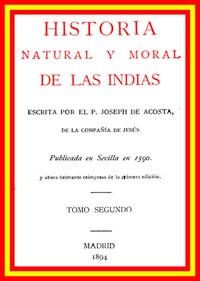
Historia natural y moral de las Indias (vol. 2 of 2) by José de Acosta
This isn't a novel with a plot, but the 'story' here is the journey of understanding itself. In this second volume of his massive work, Father José de Acosta moves from describing the physical landscape of the Americas to trying to explain its peoples and cultures. He documents the social structures, laws, and religions of empires like the Inca and Aztec with a detail that's often surprisingly respectful. He's clearly impressed by their engineering and governance. But the whole time, he's wrestling with a huge problem: The Bible and ancient philosophers like Aristotle didn't mention any of this. How could such advanced civilizations exist in total isolation from the 'known' world? The book is his attempt to fit these square pegs into the round holes of 16th-century European thought.
Why You Should Read It
You should read this because it lets you watch a smart, curious person think in real time. Acosta is sometimes wrong by our standards, but he's rarely dismissive. His confusion is honest. When he sees a llama for the first time, he doesn't just call it a weird camel; he tries to figure out its place in God's creation. When he learns about Inca record-keeping with knotted strings (quipus), he's genuinely intrigued by its complexity. The tension is compelling—here's a man loyal to his faith and king, yet confronted with evidence that challenges the very foundations of his worldview. You see the seeds of modern anthropology and natural science sprouting, even as they're tangled in the roots of colonial ideology.
Final Verdict
This book is perfect for history buffs who want to go beyond dates and battles to see how ideas collide. It's for anyone interested in the messy, human process of discovery. It's not a light read—the language is old and the concepts are dense—but it's incredibly rewarding. You won't agree with Acosta on everything (and you shouldn't), but you'll come away with a much richer, more complicated picture of the moment when two halves of the world finally met and tried to explain each other. Think of it as primary source material for a cosmic first contact story, written by one of the contactees.
There are no legal restrictions on this material. Share knowledge freely with the world.
Sarah Miller
7 months agoThe information is current and very relevant to today's needs.
William Rodriguez
1 month agoRight from the opening paragraph, it addresses the common misconceptions in a very professional manner. This is a solid reference for both beginners and experts.
Daniel Jackson
1 year agoGreat read!
Edward Johnson
4 months agoTo be perfectly clear, the author's voice is distinct and makes complex topics easy to digest. I couldn't put it down.




George Lee
2 years agoHaving followed this topic for years, I can say that the practical checklists included are a great touch for real-world use. The price-to-value ratio here is simply unbeatable.