
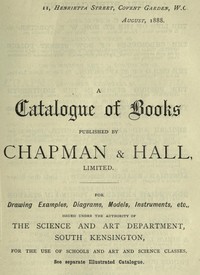
A Catalogue of Books Published by Chapman & Hall, Limited, August, 1888
Let's be clear from the start: this isn't a story in the traditional sense. There's no protagonist, no villain, and definitely no dramatic climax. 'A Catalogue of Books Published by Chapman & Hall, Limited, August, 1888' is exactly what the title says—a list. But what a list it is. It's a frozen moment in publishing history, a spreadsheet of the Victorian imagination.
The Story
There is no plot. Instead, you turn the pages and walk the aisles of a long-vanished bookstore. You'll find Charles Dickens's works prominently featured (the firm was his publisher), alongside new novels with thrilling titles hinting at far-off adventures and domestic dramas. There are dense scientific treatises, travelogues from every corner of the British Empire, practical guides on farming or etiquette, and collections of poetry. The 'story' is in the sheer variety. It shows a society hungry for knowledge, escape, and self-improvement, all at the same time. You see what was popular, what was considered important, and what was just coming into fashion.
Why You Should Read It
I loved it because it turns you into a literary archaeologist. You start noticing patterns. Why are there so many books on polar exploration? It tells you what was gripping the public consciousness. Seeing a three-volume novel listed for 31 shillings and sixpence makes you appreciate our modern, affordable paperbacks. Spotting an early reference to a book that would later become a classic feels like finding a treasure. It's a direct line to the past, with no filter. This catalogue doesn't tell you what historians *think* Victorians read; it shows you what they could actually buy on a given day in August. It’s raw, unfiltered cultural data.
Final Verdict
This is a niche read, but a fascinating one. It's perfect for history buffs, book collectors, and anyone obsessed with the Victorian era. If you love Dickens, this is the commercial world he operated in. If you're a writer, it's a humbling and inspiring look at the marketplace of ideas over a century ago. It's not for someone looking for a gripping narrative. But if you've ever stared at your own bookshelf and wondered what it says about you, this catalogue lets you do that for an entire society. Think of it as the most detailed, accidental biography of a reading world ever published.
This work has been identified as being free of known copyright restrictions. It serves as a testament to our shared literary heritage.
Emily Davis
1 year agoVery helpful, thanks.
Aiden Williams
1 year agoComprehensive and well-researched.
Mary Jackson
9 months agoSolid story.
Mark Gonzalez
1 year agoVery interesting perspective.





Margaret Thompson
6 months agoThe clarity of the concluding remarks is very professional.